


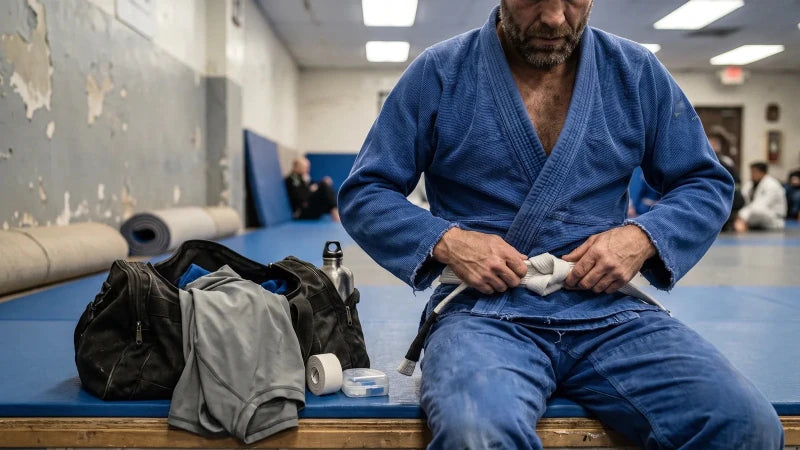
You do not need a cart full of accessories to start Brazilian Jiu-Jitsu. You need gear that fits, follows your academy's rules and can be cleaned after every class.
For gi class: start with a gi, belt, suitable undergarments, mouthguard if you choose to wear one, water bottle and a bag for clean and used gear. For no-gi: start with a fitted rash guard and grappling shorts; add spats only if your academy and competition rules allow them.
BJJ gear checklist
| Item | Gi class | No-gi class | Buy first? |
|---|---|---|---|
| Gi jacket and pants | Required | No | Yes, if your academy trains in the gi |
| Belt | Required | Rank is shown through approved uniform colors in some competitions | Yes; use the BJJ belt rankings and promotion guide for the progression context |
| Rash guard | Academy- and rules-dependent under the gi | Core uniform | Yes for no-gi |
| Grappling shorts | No | Core uniform | Yes for no-gi |
| Spats | Rules-dependent | Optional in training; competition rules vary by division | Later |
| Mouthguard | Optional but common | Optional but common | Personal decision |
| Finger tape | Useful for some athletes | Less central | Later |
| Ventilated gear bag | Useful | Useful | Yes if you travel to class |
1. Choose the gi by fit first
BJJ gi sizing is not universal. Use the exact brand's height-and-weight chart, then confirm sleeve length, pant length, torso room and squat mobility before washing.
The jacket should close with useful overlap without swimming around the torso. Sleeves and pants need enough length to survive any expected shrinkage while still passing competition inspection.
Our BJJ gi buyer's guide covers fit and current options. The lightweight versus heavyweight gi guide explains GSM, weave and competition weight, while how BJJ gear construction evolved gives the historical context without turning old equipment into a buying rule.
Browse current BJJ gis only after measuring yourself. Product titles are not a substitute for the size chart. If FUJI is on your shortlist, read the current FUJI BJJ gi comparison before relying on an old model claim.
2. Build a no-gi uniform that stays put
A no-gi rash guard should fit close without restricting a full breath or shoulder rotation. Look for flat seams, a hem that does not ride up and fabric that recovers after stretching.
Shorts should let you squat and pummel without loose hardware, open pockets or exposed fasteners. Spats add skin coverage but do not replace competition-legal shorts in every ruleset.
Read the no-gi BJJ gear guide, then compare the current rash guard range.
3. Know the current competition rules
The current IBJJF uniform requirements permit gi colors of white, royal blue or black, require approved measurements and patch zones, and prohibit wet, dirty, torn or unpleasant-smelling gis.
For no-gi, IBJJF requires a skin-tight elastic shirt in approved colors with rank-color coverage. Shorts and compression garments have specific color, length and hardware rules. Other organizations and academies may differ, so always check the event page and your coach's instructions.
If you add patches or embroidery, use the BJJ gi customization guide before altering a competition gi.
4. Accessories: useful beats impressive
A practical kit usually includes:
- A mouthguard that fits securely and lets you breathe and communicate.
- Finger tape and small rounded-tip scissors if you use tape.
- A water bottle.
- Nail clippers stored safely away from loose gear.
- A dry change of clothes.
- A separate wet bag or washable compartment for used gear.
Ear guards, braces and other protective equipment should fit the class rules and your actual need. See the ranked BJJ accessories guide before buying extras.
5. Women's fit is a real sizing decision
Some athletes fit a standard unisex cut. Others need a shorter sleeve, different rise, more hip room or a narrower jacket. The label “women's” does not guarantee any of those changes.
Our women's BJJ gear guide shows how to compare actual measurements rather than body-type marketing.
6. Pack clean gear and a plan for used gear
A good gym bag separates clean items from damp gear. Ventilation helps during the trip home, but it does not replace washing. Remove every used item as soon as you get home. The combat-sport gym bag packing guide shows how to build that clean-versus-used system.
Compare gym bags and backpacks by compartment layout, washable lining and whether they fit your gi without crushing everything else.
7. Wash after every session
- Check the care label.
- Wash the gi, rash guard, shorts and spats after use.
- Avoid leaving damp gear sealed in the bag.
- Air-dry when the product instructions recommend it.
- Inspect seams, collars, knees and elastic before the next class.
For a full routine, read the BJJ gi care guide.
What to buy first
- The uniform your academy requires.
- A second clean training set once you train often enough to need rotation.
- A bag and wet-storage system.
- Only then, accessories that solve a problem you have actually encountered.
Your first class, first month and first competition
Before the first class
Ask the academy whether the session is gi or no-gi and whether loan gear is available. Confirm uniform color, footwear rules around the mat and any restrictions on cups, braces or jewellery. That one message can prevent an unnecessary order.
After the first month
Buy a second training set only when the laundry cycle proves you need it. Add tape, ear guards or supports because a real issue appeared, not because a generic checklist called them essential. The goal is to arrive in clean gear consistently.
Before the first competition
Separate training comfort from event legality. Check the current organizer rules, inspect the uniform after washing and pack an approved spare when practical. Test every layer together before travel.
What belongs in the bag on a normal night
Pack one complete clean uniform, water, a mouthguard if you use one, a small hygiene pouch, sandals for the changing area where required, and dry clothes for the trip home. Put a washable wet bag inside the main bag before class so used gear never touches the clean change.
Leave hard recovery tools, loose scissors and half the medicine cabinet at home. A training bag should be easy to empty and clean, not a permanent storage unit.
Build a two-uniform rotation
When training frequency increases, the useful upgrade is often another clean gi or no-gi set. Label-led washing and full drying take time. A second set prevents the temptation to wear damp gear or use excessive heat just to make the next class.
The two sets do not have to match. A lighter option can handle hot sessions or travel; a more substantial option can take regular academy work. Both still need to fit and follow academy rules.
Gear cannot solve a training problem
A new weave will not repair poor guard posture. Compression clothing will not create endurance. A brace should not become permission to ignore pain. Buy equipment for fit, hygiene, rules and a defined use—not as a substitute for coaching or recovery.
Rules sources
Competition rules change. These are the current primary pages to recheck before registration or travel.
Frequently asked questions
Do I need both gi and no-gi gear?
Only if your academy schedule includes both. Ask what the first class requires before buying.
Can I wear a T-shirt for no-gi?
Some academies allow it for a first class, but a fitted rash guard is the normal long-term choice. Competition rules are stricter.
How many gis do I need?
One is enough to start. Add a second when your training frequency makes it difficult to wash and fully dry the first before the next class.
Should beginners buy a competition gi?
Not unless competition is already planned. Fit, academy rules and easy care matter more for a first training gi.