


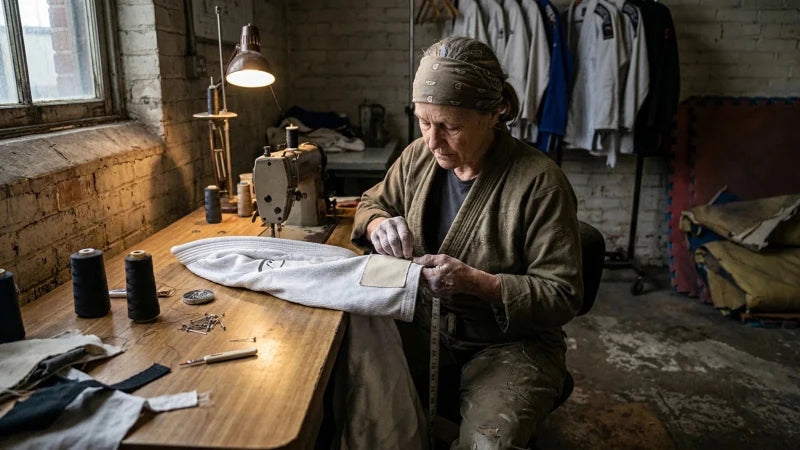
A patch can look perfect and still get removed at gi inspection.
For IBJJF events, the current rule is straightforward: patches belong only in the authorized regions shown in the official uniform guide, must be made from cotton fabric and must be properly seamed. Unseamed patches or patches in unauthorized areas can be removed by inspectors.
That makes the order of work important: check the current rules and tournament notice first, place the design second, sew it last.
Before you customize a BJJ gi
- Open the current IBJJF uniform requirements.
- Check the official patch-zone diagram, not an old placement graphic from a blog or social post.
- Read the rules for the specific event you plan to enter.
- Ask your academy whether team branding or affiliation placement is required.
- Confirm the gi already fits within competition measurements before adding anything.
- Give the finished gi enough time for sewing, washing and a final inspection.
Embroidery or patch?
Direct embroidery
Embroidery is stitched directly into the gi. It produces a clean permanent result, but the needlework can stiffen or distort the panel if the design is too dense or the backing is poorly chosen.
Before approving the job, ask the embroiderer how the backing, stitch density and thread will behave on pearl weave, ripstop or the specific fabric in your gi. Do not embroider across a seam, collar or area that must remain flexible unless the gi maker and competition rules permit it.
Sewn patch
A sewn patch is easier to position before committing. For IBJJF competition, the official uniform page says patches should be cotton fabric and properly seamed in authorized areas.
Sew all edges flat. Loose corners give fingers and toes something to catch and may fail inspection.
Iron-on, adhesive and hook-and-loop patches
These may work for non-competition gear, but do not assume the backing alone makes a competition patch acceptable. The current IBJJF wording requires patches to be properly seamed. If you plan to compete, sew the patch and verify its placement.
Current IBJJF checks that affect customization
The IBJJF uniform page currently states that:
- the gi must be a uniform white, royal blue or black
- the top and pants cannot be different colors
- the collar cannot be a different color from the top
- paint is prohibited except an academy or sponsor logo in a region where patches are permitted
- a painted logo that marks an opponent can still require a gi change
- patches are allowed only in the authorized regions shown in the official guide
- patches should be cotton fabric and properly seamed
- a gi cannot be torn, mended, wet, dirty or unpleasant-smelling at inspection
Do not rely on the old universal patch-size tables that circulate online. Use the current zone diagram and event rules.
A practical placement process
- Put the clean gi on. Make sure it fits before spending money on customization.
- Print or open the current zone diagram. Identify the exact authorized panel.
- Pin or tape a paper mock-up in place. Move through a squat, frames and shoulder rotation.
- Check seams and grip areas. Keep the design flat and away from anything that bunches or rubs.
- Confirm academy and sponsor approval. Ownership of a logo does not automatically give you permission to use it.
- Use an experienced shop. Give them the gi, the approved artwork and the placement reference together.
- Inspect after sewing. Look for puckering, loose thread, exposed backing and unsewn edges.
- Wash once before the event. Follow the gi and decoration care instructions, then inspect again.
Competition-day gi checklist
- Uniform color is white, royal blue or black for an IBJJF event.
- Jacket and pants match.
- Patches sit entirely inside the current authorized zones.
- Every patch edge is properly seamed.
- No patch corner, embroidery thread or backing is loose.
- The gi has no tears or unauthorized mending.
- The gi is clean, dry and free of strong odor.
- Sleeves, pants, collar and lapel still meet the current inspection measurements.
- The specific tournament has not published an additional requirement.
- A plain backup gi is packed when the event rules allow or require one.
For the current sleeve, pants and collar measurements, use our BJJ gi sizing and buying guide. For washing after embroidery or patching, follow the BJJ gi care guide.
What to customize
The safest designs have a real job: academy identification, a sponsor you are authorized to represent, your name for team travel, or a symbol that matters to you.
More is not automatically better. A few clean elements are easier to place, sew, inspect and maintain than a gi covered in competing graphics.
Choosing a gi before customization
Do not decorate a gi you have not tried on. Fit can change your placement, and a customized item may not be returnable.
Browse the current BJJ gi collection, confirm the live size chart and return terms, then train or compete in the unmodified gi only after you know the fit is right. Our complete BJJ gear guide covers the rest of the kit.
Three customization approaches that age well
Academy-first
Start with the academy patch in the required location and stop there until the gi has survived a few washes and rounds. This keeps team identification clear and leaves room for a future sponsor or event requirement.
Minimal personal
A small name, initials or meaningful symbol can make travel gear easier to identify without turning every panel into a design problem. Keep the stitch density appropriate for the fabric and avoid high-friction areas.
Competition and sponsor layout
Map every logo on a current rules diagram before sewing. Get written permission for artwork, confirm academy policy and leave enough time to wash and re-inspect the finished gi before the event.
What to give the embroidery or patch shop
- The clean, correctly sized gi.
- Vector or high-resolution artwork you are allowed to use.
- The exact finished dimensions.
- A printed placement reference from the current rules.
- Thread, backing and edge-finish expectations.
- A deadline that includes one wash and final inspection.
Ask for a physical placement proof before the machine starts. Moving a paper mock-up takes a minute; removing dense embroidery from pearl weave can damage the jacket.
Repairing or removing customization
Loose patch edges should be repaired before training. If a patch must be removed, cut the attachment stitches carefully from the patch side and stop if the gi fabric begins to lift. Dense embroidery is not safely reversible in every fabric.
If a modification leaves holes, a stiff backing or a visible repair, recheck competition legality. A plain training gi is a better outcome than forcing a damaged customized gi through inspection.
Rules sources
Competition rules change. These are the current primary pages to recheck before registration or travel.
Frequently asked questions
Where can patches go on an IBJJF gi?
Only in the authorized regions shown in the current IBJJF uniform guide. Use the official diagram because a written shortcut can miss panel boundaries.
Can I embroider my name on a BJJ gi?
You can customize a training gi if the academy and gi owner permit it. For competition, verify that the placement and finished work meet the governing event's current rules.
Are iron-on patches legal for competition?
Do not rely on adhesive alone. The current IBJJF uniform page says patches should be properly seamed. Sew the patch and keep it within an authorized zone.
Can I use a sponsor or academy logo?
Only when you have permission to use the artwork and the finished placement follows the event rules. Your academy may also have its own branding requirements.
Should I customize a new gi immediately?
No. Confirm the fit, color, measurements and return decision first. Customization can make an otherwise returnable gi yours for good.