


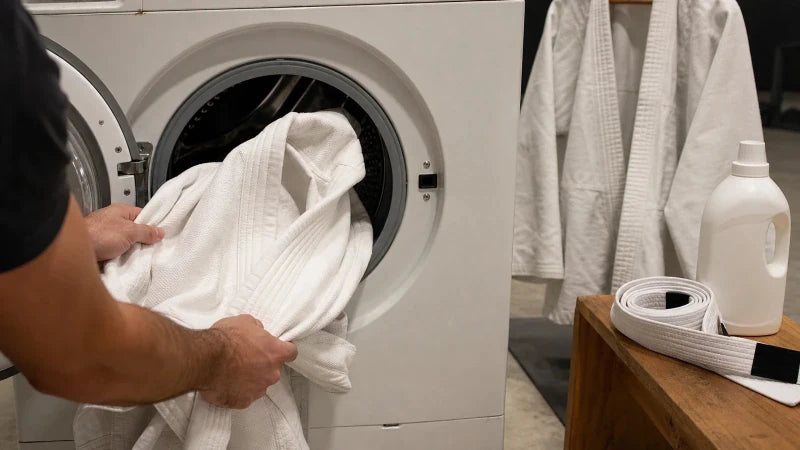
Wash your BJJ gi after training, but let the care label control the method. Cold washing and hang drying are common instructions on current gis, including current FUJI and Hayabusa models. They are not permission to ignore the label on your exact jacket and pants.
The two biggest avoidable mistakes are leaving a sweaty gi closed in a bag and using heat to “dial in” the fit. Moisture creates odor and mildew risk; heat can shrink parts of the uniform unevenly.
If you are still choosing a uniform, read our BJJ gi buyer's guide before washing anything. A worn or washed gi may no longer be returnable.
BJJ gi care at a glance
| Situation | Best first move | Avoid |
|---|---|---|
| After class | Take the gi out of the bag and wash it promptly | Leaving it damp and compressed overnight |
| Routine wash | Follow the label; cold water is common on current models | Assuming one temperature suits every fabric and decoration |
| Drying | Hang dry when the manufacturer specifies it, with good airflow | High heat unless the care label explicitly allows it |
| Stain | Rinse or pre-treat with a product safe for that color and fabric | Untested bleach, peroxide or home-remedy mixtures |
| Persistent odor | Rewash and dry fully; inspect for mildew or trapped residue | Covering it with fragrance and returning it to the bag |
Step 1: get it out of the bag
As soon as practical after training, remove the jacket and pants from the gym bag. If you cannot start a wash immediately, spread them out in a ventilated place instead of leaving them rolled with a wet rash guard and towel.
Check the care label, empty any pockets and close hook-and-loop contact from other laundry so it cannot abrade the gi. Wash white and strongly colored items separately when dye transfer is a concern.
Step 2: wash the exact material correctly
Care labels on current FUJI and Hayabusa gis commonly specify cold washing and hang drying, with warnings about bleach or heat. Treat that as a pattern to check, not a substitute for the label sewn into your own jacket and pants.
Use those instructions as a sensible reference, not a universal law. A gi can combine a cotton jacket, blended pants, foam or EVA in the collar, embroidery and patches. The manufacturer's sewn-in label wins when instructions differ.
- Use an appropriate amount of normal laundry detergent for the machine and load.
- Do not add bleach, softener, vinegar or another treatment unless the care label and product directions allow it.
- Give the gi enough room to move and rinse; overloading can leave soil and detergent behind.
- Do not wash a belt, rash guard or protective item on the gi's instructions by default. Check each label.
Step 3: handle stains without damaging the gi
Treat a fresh stain before drying it. For blood, start with cold water because heat can set protein stains. Then use a laundry treatment that is compatible with the garment's color, fiber and decoration, following that product's directions.
Test any unfamiliar treatment on a hidden area. Chlorine bleach can weaken fabric and strip color; peroxide can also affect dyes. “Natural” does not mean safe for every gi.
Step 4: dry for airflow, not speed
If the label says hang dry, place the gi where air can move around the jacket and pants. Open the lapels, separate heavy folds and make sure the waistband and collar dry completely. Direct sun may fade colors, so use shade or indirect light when appearance matters.
Do not publish a fixed drying temperature or guaranteed shrink percentage. Cotton content, weave, previous washing and garment construction all change the result. A tumble dryer can be convenient, but use it only within the label's instructions and accept that heat may alter fit.
Pre-shrunk does not mean shrink-proof
“Pre-shrunk” means the manufacturer has taken steps to reduce later dimensional change. It does not mean the gi cannot shrink. Current gi care guidance also makes clear that pre-shrunk fabric can still change size and that warm water or tumble heat can alter fit.
Do not buy an oversized gi with a plan to shrink it into a precise shape. Sleeves, skirt, trousers and collar do not necessarily change at the same rate. If the unwashed fit is wrong, use the return route before heat turns the sizing problem into a permanent one.
How to deal with odor
First, fix the workflow: wash after use, use enough detergent for the load, rinse properly and dry completely before storage. Do not store a clean gi while any thick area is still damp.
If odor remains, rewash according to the label and inspect the machine, bag and storage space. A clean gi placed back into a dirty, wet gym bag can pick up the same smell. Clean the bag according to its own instructions.
Retire a gi when fabric is thinning, seams are failing, tears cannot be made competition-safe, or mildew and odor remain after correct laundering. There is no reliable “one to two year” replacement rule; use condition, not the calendar. When replacement is necessary, compare the current BJJ gi collection by fit, construction and care requirements.
Store only when fully dry
Fold or hang the gi in a dry, ventilated place. Long-term direct sun can fade it, and a sealed plastic bag can trap residual moisture. Before the next class, check the collar, underarms, knees, drawstring and reinforced seams.
For a complete kit routine, use our BJJ gear checklist. If you rotate between different uniform weights, the gi weight guide explains why drying time and feel can differ.
A laundry workflow that survives a busy week
When you get home, empty the whole bag. Put the gi into the correct wash, open the wet compartment and let the bag dry. Check the mouthguard case and base layers separately. The workflow fails when one damp item stays hidden under the belt until morning.
Set the next uniform out only after it is completely dry. If you train again before laundry can finish, the real solution is another clean set—not hotter water or a rushed dryer cycle that changes the fit.
Care for patches and embroidery
Turn a decorated gi inside out when the label permits and close anything in the load that could catch the stitching. Inspect patch corners before washing. A loose edge can pull farther in the machine and become a snag point during class.
Do not iron or apply stain treatment directly to a decoration without checking its material. Thread, printed patches, backing and the gi fabric can tolerate different temperatures and chemicals.
When you cannot wash immediately
During travel or a long tournament day, remove the gi from the sealed bag as soon as practical and spread it where airflow is permitted. That does not make it clean enough to wear again. It only prevents hours of damp compression before you can wash it properly.
Carry a separate wet bag so used gear does not contaminate the clean backup. When you reach laundry, follow the same label-led process rather than pouring in extra detergent to compensate for the delay.
Retire, repair or keep training?
Loose surface thread may be repairable. A knee panel thinning through, a collar splitting, a drawstring channel tearing or fabric that remains unpleasant after correct washing deserves a closer decision. Competition rules can reject mended or damaged uniforms even when an academy still allows them for drilling.
Keep a worn but safe gi for light training only when the academy accepts it. Do not let sentimental value turn exposed reinforcement or failing seams into a partner hazard.
Frequently asked questions
Should I wash my BJJ gi after every class?
Yes. Wash a used gi before wearing it again, using the instructions on that garment. If washing must wait briefly, remove it from the bag and ventilate it.
Can I put a BJJ gi in the dryer?
Only if the care label allows it. Many current gis specify hang drying and warn that tumble heat can shrink the uniform.
Can I use bleach on a white gi?
Do not assume white fabric makes bleach safe. FUJI, for example, says not to bleach its current gis. Check the exact label and any patch or embroidery restrictions.
How do I stop a gi from shrinking?
Follow the label, avoid unapproved heat and do not use intentional shrinking as a sizing method. Some dimensional change may still occur even on pre-shrunk models.
How many gis should I own?
Enough to wear a clean, fully dry gi each session. The right number depends on training frequency, laundry access and drying time, not a universal rule.