


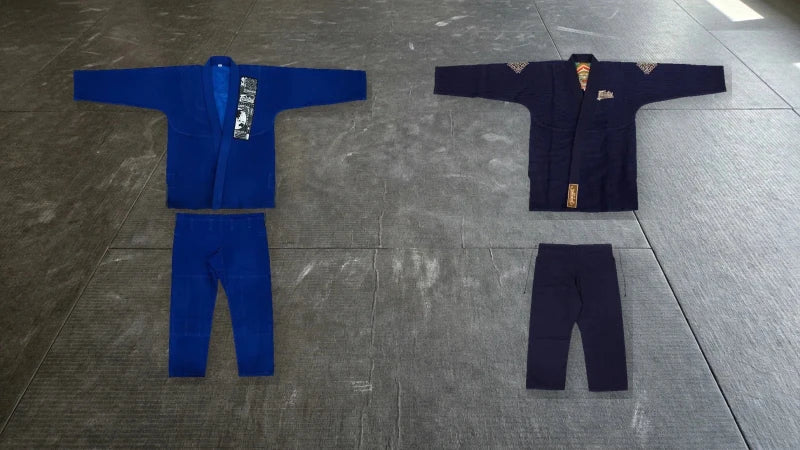
Choose a lightweight gi when heat, travel or making a competition limit matters. Choose a heavier gi when you prefer a more substantial fabric and daily training durability matters more than scale weight.
Do not turn GSM into a quality score. GSM describes fabric mass per square metre, usually for the jacket. It does not tell you the total dry weight of the jacket, pants, reinforcements and belt.
Start with the complete BJJ gear guide if you are building your first kit.
Lightweight vs heavyweight at a glance
| Factor | Lightweight gi | Heavier gi |
|---|---|---|
| Jacket fabric | Lower GSM in the same product family | Higher GSM or denser construction |
| Heat | Usually easier to tolerate in hot rooms | Usually warmer |
| Travel and laundry | Packs smaller and often dries faster | Bulkier and may take longer to dry |
| Scale weight | More room under a competition limit | Less room under the same limit |
| Grip feel | Thinner fabric may be easier to bunch | More substantial fabric can feel harder to gather |
| Durability | Depends on weave, seams and reinforcements | More material can help, but construction still decides |
What GSM does and does not tell you
A 350 GSM jacket uses less fabric mass per area than a 550 GSM jacket. That is useful, but it is not the whole uniform weight.
Pants may be measured in ounces or described by material rather than GSM. Lapels, embroidery, knee panels, seam tape and size all change the weight on the scale. Weave names such as pearl weave and gold weave are also not perfectly standardized across brands.
Compare the full product specification and weigh the complete dry uniform you will actually wear.
Current examples
The Hayabusa Ultra-Light BJJ Gi uses a 350 GSM pearl-weave cotton jacket with lightweight ripstop pants. The Fairtex Exosphere BJJ Gi uses a 380 GSM pearl-weave jacket and 280 GSM ripstop pants.
For a more substantial option, the Hayabusa Essential Gold Weave Gi uses a 550 GSM jacket. Stock varies by size, so use the live selector.
See the current BJJ gi collection for the full range, then use each product's size chart.
Competition weight: the practical difference
IBJJF states that gi competitors weigh in with the gi, immediately before the first fight, with one opportunity to make the limit. The official IBJJF weigh-in page is the source to check, along with the event's own important information.
That means the relevant number is your body weight plus the complete competition uniform. Do this check at home:
- Dry the gi completely.
- Put on the same undergarments, gi and belt you will wear.
- Use a reliable scale under similar conditions.
- Leave a margin instead of planning to land exactly on the limit.
- Recheck the event's official unit and weight chart.
A lighter gi can create useful margin. It does not make you faster by magic, and a heavy gi does not create automatic pressure.
Which gi is better for training?
For hot rooms and frequent washing: a lightweight or midweight gi is usually easier to rotate.
For hard daily use: a more substantial gi can make sense, but inspect the knees, collar, armpits and seams rather than relying on GSM alone.
For one-gi beginners: a midweight, easy-care gi often offers the least complicated compromise.
Fit still outranks weight
A perfect fabric weight is useless if the sleeves fail inspection or the pants restrict a squat. Use the BJJ gi sizing and buying guide before choosing between two weights.
Use IBJJF's current uniform page for permissible colors, measurements and inspection details.
How the difference shows up during a round
A lighter jacket usually feels less bulky when you are hot and moving through repeated rounds. It can also be easier for an opponent to gather because there is less substantial fabric. A heavier jacket can feel harder to bunch but carries more heat and water when the room is humid.
Those are tendencies, not automatic tactical advantages. Cut and fit still decide how much material is available. A loose lightweight gi can offer more usable grip than a close-fitting heavier one.
Run a real competition weigh-in rehearsal
Do not subtract a catalog weight from the division limit. Wear the same dry gi, belt and undergarments you plan to use and step on a reliable scale. Repeat on more than one day, under similar conditions, and leave margin for scale differences.
The Hayabusa Ultra-Light BJJ Gi or Fairtex Exosphere BJJ Gi may create useful room compared with a more substantial model such as the Hayabusa Essential Gold Weave Gi. The exact difference depends on your size and complete uniform.
Heat, travel and drying time matter every week
Weight is not only a competition question. A lighter uniform takes less suitcase space, feels less oppressive in a hot room and will often dry sooner after washing. That can matter more than a small difference in fabric feel when you train several times a week and cannot use a dryer.
A heavier gi earns its place when you prefer a more substantial jacket, train in a cooler room or want one durable-feeling uniform for ordinary classes. It still needs to fit correctly and dry completely before the next session. If the laundry window is the real problem, buying a second clean rotation may solve more than chasing the lightest possible fabric.
Own two weights for two jobs
Many regular practitioners do not need to declare allegiance to light or heavy. A lighter gi can handle hot classes, travel and competition prep. A midweight or heavier gi can be the daily option when drying time and scale margin are not tight.
That rotation also reduces rushed laundry. The best second gi is often the one that covers the conditions your first one handles poorly.
Rules sources
Competition rules change. These are the current primary pages to recheck before registration or travel.
Frequently asked questions
What counts as a lightweight BJJ gi?
There is no universal official category. Brands commonly market lower-GSM jackets as lightweight, but compare the complete uniform weight and construction.
Are lightweight gis competition legal?
They can be if they meet the event's material, color, fit and inspection requirements. “Lightweight” on the product page is not approval by itself.
Do heavier gis last longer?
Sometimes, but GSM is not a warranty. Weave, seams, reinforcements, washing and training volume all affect wear.
Which is better for a beginner?
Choose the gi that fits, follows academy rules and can be washed and dried between sessions. A comfortable midweight gi is often the simplest first purchase.