


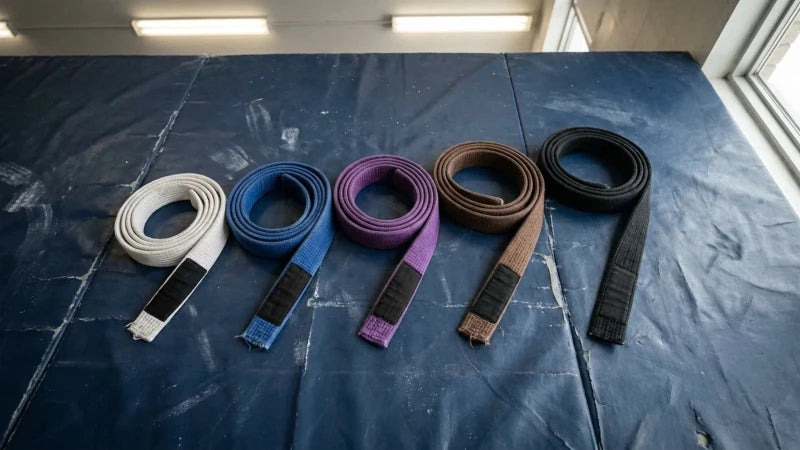
The adult Brazilian Jiu-Jitsu belt order is white, blue, purple, brown and black. That sequence is easy to remember. The difficult part is that no universal list of techniques, class hours or tournament wins automatically earns the next belt.
Your instructor or academy decides when you are ready to be promoted. The International Brazilian Jiu-Jitsu Federation publishes a graduation system for ranks it recognizes, including age rules and minimum periods, but that system is not a promise that promotion happens on a fixed date.
If you are new to the sport, pair this overview with our complete BJJ gear guide. The belt matters, but a clean uniform that fits your academy's rules matters before your first class. Compare the current BJJ gi collection only after confirming the uniform policy with your school.
Adult BJJ belts at a glance
| Belt | What it usually signals | What it does not guarantee |
|---|---|---|
| White | The starting rank for most adult practitioners | A fixed beginner curriculum shared by every academy |
| Blue | A working foundation and the ability to train with more independence | Mastery of every position or a set number of competition wins |
| Purple | A more developed personal game and stronger technical connections | A universal teaching role or identical standard at every school |
| Brown | Advanced application, refinement and preparation for black belt | Automatic promotion after a fixed number of months |
| Black | A high level of recognized technical development | The end of learning or the same competition level for every practitioner |
Those descriptions are deliberately broad. A hobbyist, academy coach and active competitor can hold the same belt while having very different strengths. Rank is an instructor's judgment inside a school and, where relevant, a registered status inside a governing body's system.
How BJJ promotions actually work
Most instructors look at more than one signal. Technical understanding matters, but so do timing, control, decision-making, defense, consistency and how well a student applies technique against appropriate resistance. Academies can also value attendance, competition, teaching or conduct differently.
That is why claims such as “blue belt takes exactly two years” or “purple belt requires a specific number of training hours” are misleading. Training frequency changes. Time away changes. Previous grappling experience changes. The instructor responsible for the promotion sees the full picture.
Where IBJJF rules fit
The IBJJF system standardizes ranks for its registration and competition structure. Its current guidance covers age eligibility, minimum graduation periods, who may sign a promotion and degrees beyond black belt. The federation also warns that the system can change as the sport develops.
Use the current official document before registration rather than relying on an old chart. Recent IBJJF updates, for example, changed minimum-period treatment for certain adult world champions. That alone is a good reason not to hard-code a universal promotion timeline into a training plan.
What do stripes mean?
Stripes are intermediate markers used by many academies, often to show progress within a belt. Their meaning is not perfectly standardized. One school may use formal tests; another may award stripes through ongoing instructor assessment; some adult programs use them sparingly.
Do not compare your stripe pace with a teammate at another academy as though both schools use the same measuring system. Ask your instructor what stripes mean where you train.
Children's belts are a separate system
Children do not simply move through the adult white-to-black sequence. The IBJJF publishes youth ranks and suggested children's graduation structures with additional colors and subdivisions. Age affects when a student can move into juvenile or adult ranks.
Parents should check the academy's system first and the current governing-body document if the child competes. An old internet infographic can be wrong even when the color order looks convincing.
Does your belt affect your gear?
For gi training, wear the belt your instructor awarded. For IBJJF competition, the current uniform rules specify belt width, rank color, tip color and how the belt must be tied. The rules also connect rank color to parts of the no-gi uniform.
A new belt does not mean you need to replace every piece of gear. You may need a rank-compliant rash guard for competition; our no-gi gear guide explains the current uniform requirements. For gi events, verify the gi, belt and patches together before travel.
How to think about your next promotion
- Train consistently enough for your instructor to assess your actual game.
- Ask for specific technical feedback, not a prediction of your promotion date.
- Fix repeated decision-making errors instead of collecting disconnected techniques.
- Use competition as feedback if it fits your goals, not as a guaranteed promotion transaction.
- Check current federation rules only when registration or competition recognition makes them relevant.
The useful question is not “How quickly can I get the next belt?” It is “What part of my jiu-jitsu fails repeatedly, and what should I work on next?” The belt follows the development; it cannot replace it.
What changes from belt to belt
White belt: the main job is learning to train safely, recognize positions and survive long enough to make a decision. Progress can be real before the athlete has an impressive attacking game.
Blue belt: isolated techniques begin to connect. A blue belt may have reliable routes from a few positions while still finding major holes elsewhere.
Purple belt: the personal game becomes clearer. The athlete can usually explain why one choice leads to the next and adapt when the first route fails.
Brown belt: timing, pressure and small technical details are refined against experienced partners. The game may look simpler because the decisions are better.
Black belt: the rank recognizes deep development; it does not make every black belt identical. Teaching, competition, age, size and specialization still produce different strengths.
These are useful descriptions, not a promotion checklist. An instructor can reasonably weigh the same evidence differently.
Switching academies can slow the visible timeline
A new instructor needs time to understand how you train, how consistent you are and what your previous rank represented. That is not necessarily punishment or “starting over.” It is a new coach taking responsibility for the next promotion.
Bring an honest training history, wear the rank already awarded and ask how evaluation works at the new academy. Avoid pressuring the coach with a predicted date from the previous school.
Competition divisions and belt rank
Competition places you in a belt division; it does not define the entire standard for promotion. A strong result can show that a game works under pressure. A loss can expose a gap. Neither creates an automatic transaction.
Use the tournament as a diagnostic. Bring the repeated failure back to class, and let the instructor decide how it fits the wider promotion picture.
Parents should treat youth ranks separately
Children's belt systems include more colors and age transitions. Growth, attendance and academy curriculum make direct comparisons especially weak. Use the current youth graduation document and the academy's explanation rather than projecting the adult five-belt sequence onto a child.
Rules sources
Competition rules change. These are the current primary pages to recheck before registration or travel.
Frequently asked questions
What is the BJJ belt order for adults?
The standard adult sequence is white, blue, purple, brown and black. Degrees continue beyond black belt under formal graduation systems.
How long does each BJJ belt take?
There is no honest universal answer. Academy standards, training consistency, age, experience and instructor judgment differ. IBJJF minimums apply to its recognition system and should be checked in the current official document.
Do you need to compete to get promoted?
Not at every academy. Some instructors value competition heavily; others promote non-competitors through daily training assessment. Ask your instructor what evidence matters in your program.
Are stripes the same at every academy?
No. Many schools use stripes, but the tests, timing and meaning vary.