


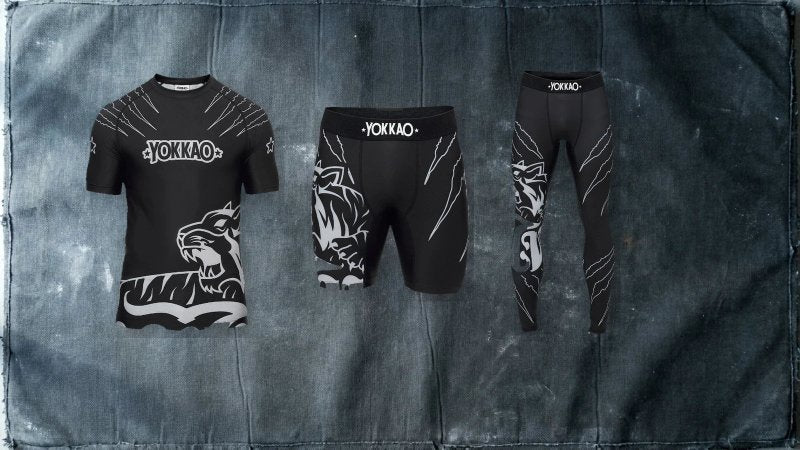
For most no-gi classes, you need two things: a fitted rash guard and grappling shorts without exposed hardware. Spats are optional in many gyms and useful for extra skin coverage, but competition rules differ.
Do not buy from a generic “approved” label alone. Check your academy rules, the event organizer and the exact product construction.
For the full gi and no-gi checklist, see the complete BJJ gear guide.
No-gi gear at a glance
| Item | Training job | Fit check |
|---|---|---|
| Rash guard | Close-fitting top that stays out of grips | Full breath and shoulder rotation without bunching |
| Grappling shorts | Secure outer layer for hip movement and contact | Deep squat without slipping, pinching or exposed hardware |
| Spats | Optional leg coverage and a layer under shorts | No sagging at knees or waistband roll |
| Compression shorts | Close-fitting base layer | Stay in place through hip movement |
Rash guards: fit before fabric claims
A rash guard should sit close to the body without restricting breathing. Raise both arms, rotate the shoulders, sprawl and sit through. If the hem rides to the ribs or the collar gaps, the cut is wrong even if the chest measurement looks correct.
Useful construction details include flat seams, stretch recovery, a collar that stays in place and a hem designed not to climb. Fabric blends vary. For example, the current Hayabusa Geo Long Sleeve Rash Guard uses a polyester-spandex blend, flatlock stitching and a silicone hem according to the store product data.
Compare the current rash guard collection by size chart and construction, not graphic alone. If you need a cut with different torso, chest or hip proportions, use the fit checks in our women's BJJ gear guide.
Long sleeve or short sleeve?
- Long sleeve: more arm coverage and less direct skin contact with the mat.
- Short sleeve: cooler for some athletes and less fabric around the forearms.
Neither improves technique. Choose the one you will train in comfortably, then confirm the event allows that sleeve length.
Grappling shorts: remove snag points
Good no-gi shorts stay secure through shots, scrambles and guard work. Look for:
- No exposed zippers, buttons, plastic or metal.
- Pockets removed, securely closed or completely stitched shut where rules require it.
- A waistband that stays covered and does not expose a drawstring.
- Enough room for a deep squat and high step without excess loose fabric.
Side slits and stretch panels can help mobility, but the waistband decides whether the shorts stay useful after ten hard rounds.
Spats: useful, not universally required
Spats give more leg coverage and can sit under shorts. They should fit like a second layer: no loose knees, no transparent overstretch and no waistband that rolls during hip movement.
Do not assume spats alone are legal for every division. Current IBJJF rules distinguish men's and women's lower-body options.
Current IBJJF no-gi uniform rules
The current IBJJF uniform requirements say both genders must wear a skin-tight elastic shirt long enough to cover the torso to the waistband. The shirt may be black, white or black-and-white with at least 10% rank color, or entirely in the athlete's rank color.
For men, approved board shorts must be black, white, black-and-white and/or rank color, with no open pockets, buttons, exposed drawstrings, zippers, plastic or metal. They must reach at least halfway down the thigh and no lower than the knee. Approved compression shorts may be worn beneath them.
For women, approved shorts, compression shorts and/or skin-tight spats use the permitted colors and must follow the current pocket, hardware and length requirements.
Rules change and other events differ. Recheck the official page and the specific event's important information before competition.
How to size no-gi gear online
- Measure chest and waist with a soft tape.
- Compare the exact product's size chart, not another item from the same brand.
- If between sizes, decide whether the brand recommends sizing by chest, height or weight.
- Keep tags on until you test a full breath, overhead reach, squat, hip escape and sprawl.
- Exchange before training if the garment restricts movement or will not stay in place.
Care after training
- Remove gear from the bag immediately.
- Follow the care label and wash after every session.
- Skip fabric softener if the manufacturer warns it can coat technical fibers.
- Air-dry when instructed; high heat can damage stretch.
- Replace gear when seams fail, fabric becomes transparent or elastic no longer recovers.
The five-movement fitting-room test
- Take a full breath and raise both arms overhead.
- Rotate each shoulder as if pummelling for an underhook.
- Drop into a deep squat without adjusting the waistband.
- Step back into a controlled sprawl.
- Sit through and perform a hip escape on a clean surface.
The rash guard should not climb to the ribs or pull at the neck. Shorts should not slide, pinch or expose a drawstring. Spats should not turn transparent at the knees or sag after the squat.
Closures and waistbands deserve more attention
A clean waistband is more important than an aggressive graphic. Internal drawstrings should stay covered. Hook-and-loop should not expose a rough edge. Any pocket that can catch a finger needs to be closed in the way the academy or event requires.
Test the exact setup together. Compression shorts can change how the outer waistband grips. A rash guard hem can stay put with one pair of shorts and ride with another.
A simple first no-gi kit
Start with one fitted long- or short-sleeve rash guard and one pair of grappling shorts. The Hayabusa Geo Long Sleeve Rash Guard is a current internal example with a close fit, flat seams and a silicone hem. Add spats for coverage only after confirming academy and event rules.
Once training frequency creates a laundry problem, buy a second set. Do not solve it by rewearing damp gear or using high heat outside the care label.
Training kit versus competition kit
Academy training can allow colors and cuts that a federation event does not. Keep the everyday kit you enjoy, but build the competition set from the current rules and test it before travel. Rank-color requirements can make a perfectly good training rash guard the wrong event garment.
Rules sources
Competition rules change. These are the current primary pages to recheck before registration or travel.
Frequently asked questions
Can I wear a regular T-shirt to no-gi?
Some gyms may allow it for a trial class. A fitted rash guard is the normal long-term option and competition rules are more specific.
Do men need shorts over spats in IBJJF no-gi?
Current IBJJF rules permit compression shorts beneath approved board shorts for men. They do not list spats as the men's outer competition uniform.
Can women compete in spats?
Current IBJJF rules permit compression pants for women when the color and construction requirements are met. Check the event page for any additional instructions.
How tight should a rash guard be?
Close enough not to flap or bunch, but not so tight that it restricts a full breath, neck comfort or shoulder movement.