


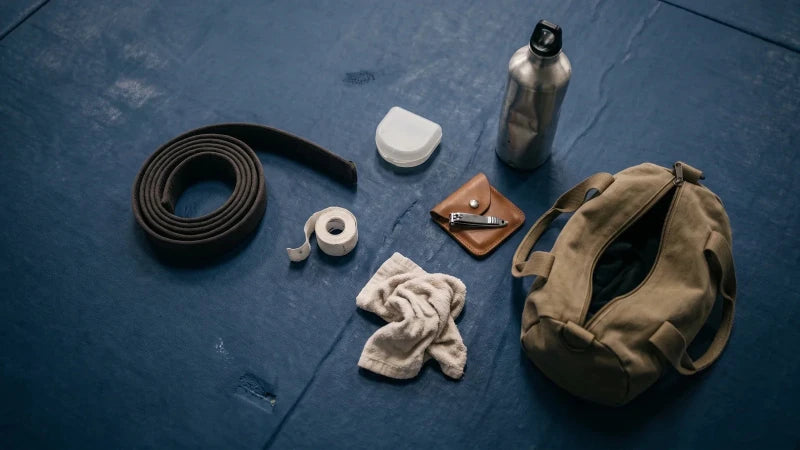
The most useful BJJ accessories solve four boring problems: keeping your mouthguard secure, protecting taped fingers, separating damp gear and getting clean before the next class.
You do not need ten gadgets. Start with the uniform in our complete BJJ gear guide, then add the items below as your training creates a real need.
BJJ accessories ranked by priority
| Priority | Accessory | Why it earns bag space |
|---|---|---|
| 1 | Mouthguard | Common, compact and useful in live grappling when properly fitted |
| 2 | Finger tape and rounded-tip scissors | Quick support for taped fingers without tearing tape with your teeth |
| 3 | Ventilated bag plus wet-gear compartment | Keeps clean items separate on the trip home |
| 4 | Water bottle | Simple hydration without leaving the mat area |
| 5 | Small hygiene kit | Nail clippers, clean towel, soap and a change of clothes |
| 6 | Spare rash guard or base layer | Useful for double sessions, tournaments or a torn first layer |
| 7 | Ear guard or support item | Useful only when it fits, the academy allows it and you have a reason |
1. A mouthguard that stays in place
A mouthguard should stay seated without constant clenching, allow you to breathe and let you communicate. A custom dental guard offers the most tailored fit; a correctly moulded boil-and-bite guard is the practical starting point for many athletes. Use the combat-sport mouthguard guide for fit, care and replacement checks.
Replace it when it tears, warps, becomes loose or can no longer be cleaned properly. Store it dry in a ventilated case.
The current store option is the YOKKAO Boxing Mouth Guard. Confirm the listed size and fit method before ordering; do not choose any mouthguard by unprovable protection percentages.
2. Finger tape and proper scissors
Finger tape is useful when you already know why and how you are taping. It should support the intended area without cutting circulation or locking the finger into a position your coach or clinician has not recommended.
Carry small rounded-tip medical scissors in a closed pouch. Do not leave loose sharp scissors in the main compartment of the bag.
3. A bag built around wet gear
The best BJJ bag has enough room for a gi, belt, base layers and a change of clothes, plus a separate washable or waterproof area for used gear.
Ventilation helps on the ride home, but used gear still needs to come out immediately. A zipped compartment is not a laundry plan.
Compare current gym bags and backpacks by opening size, compartment layout and how easy the lining is to wipe.
4. Hygiene basics
- Nail clippers for use before class, stored safely.
- Clean towel.
- Soap and shower supplies.
- Sandals for the changing-room route where your gym requires them.
- Clean clothes for the trip home.
- Washable wet bag for used uniform pieces.
Wipes are a temporary clean-up tool, not a replacement for washing yourself and your training gear.
5. A spare training layer
A spare rash guard or fitted base layer is useful for tournaments, open mats and double sessions. It also saves a session if a seam fails before class.
Use the no-gi gear guide and rash guard collection to choose a piece that stays put.
6. Ear guards, braces and supports
These are needs-based accessories. Ear guards must fit securely without hard exposed edges. Braces must be compatible with close-contact training and academy rules.
If an item is being used because of pain or a recent injury, get appropriate medical guidance. Do not use gear to hide a problem and keep training through it.
Competition bag: keep it boring
- Competition uniform plus an approved spare if possible.
- Belt and required undergarments.
- Photo identification and event documents.
- Water and simple food that fits your event plan.
- Dry change of clothes.
- Small repair and hygiene kit.
The current IBJJF uniform page is the primary source for official gi and no-gi clothing requirements. The event page can add logistics, so check both rather than packing from an old blog checklist.
Accessories to skip at first
- Grip gadgets before your hands adapt to normal training volume.
- Recovery devices you do not already use.
- Expensive “BJJ-specific” versions of ordinary containers or towels.
- Anything with hard edges, exposed metal or loose parts that cannot be used safely around partners.
Buy now, buy later, skip until needed
Buy now
Get the academy-required uniform, water bottle and a clean-versus-wet bag system first. Add a mouthguard if you choose to use one. These items support every session and are easy to justify.
Buy later
Finger tape, ear guards, a second rash guard and a compact repair kit make sense after training shows the need. You will make a better choice once you know how your fingers are taped, whether your ears are irritated and how quickly laundry dries.
Skip until a specific problem exists
Grip gadgets, massage electronics, branded organizers and large supplement kits do not belong on a beginner essentials list. They may be useful elsewhere; they are not prerequisites for learning jiu-jitsu.
Mouthguard details that matter
A mouthguard should remain seated without constant jaw tension. You should be able to breathe, speak briefly and drink after removing it. A badly moulded guard that falls loose during every exchange is not improved by a premium logo.
Clean it after use according to its instructions, let it dry in a ventilated case and inspect the bite surface. Replace it when it tears, warps, becomes loose or develops damage that cannot be cleaned.
Finger tape without turning the bag into a clinic
Carry one roll you know how to use and rounded-tip scissors in a closed pouch. Ask a coach or clinician for the taping method that fits the issue. Tape should not make a finger numb, discolored or locked into a false sense of safety.
Remove used tape before washing and never leave a loose cutting tool where a hand can find it during a hurried search.
A competition-day accessory pouch
- Photo identification and event confirmation.
- Small tape roll and rounded-tip scissors.
- Mouthguard and ventilated case.
- Hair ties without hard metal, when needed.
- Nail file or clippers stored safely.
- Simple hygiene items and a dry change.
Keep the pouch small enough to find in one movement. Tournament nerves do not improve when everything is loose at the bottom of the gear bag.
What makes a bag BJJ-friendly
The opening should accept a folded gi without forcing it through a narrow zip. The wet area should be washable. The straps should carry the real load comfortably. External mesh helps briefly, but the used uniform still comes out at home.
A normal training bag with those features can be better than a “BJJ bag” with a difficult lining and decorative compartments.
Rules sources
Competition rules change. These are the current primary pages to recheck before registration or travel.
Frequently asked questions
What should a BJJ beginner buy first?
The academy-required uniform, belt, water bottle and a way to carry used gear. Add a mouthguard and tape based on your needs.
Do I need ear guards for BJJ?
No. Some athletes use them, but fit, comfort and academy rules decide whether they make sense.
Can I keep a wet gi in my bag overnight?
No. Remove it immediately and wash it according to the care label. Damp sealed gear develops odor and can damage the fabric.
Is BJJ finger tape required?
No. It is optional. Learn a suitable taping method before wrapping joints at random.