


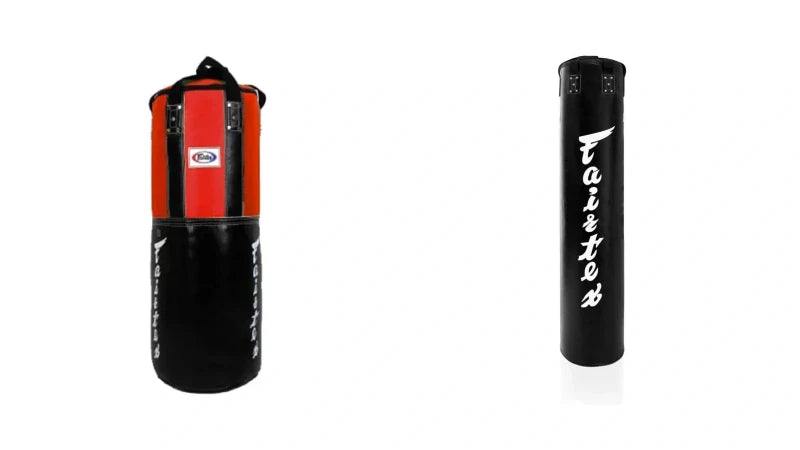
The right heavy bag is the one that fits three things at once: what you train, where you will put it, and how you want it to move.
That sounds obvious. It is also where most bad purchases start. A long banana bag can be useful for low kicks, but awkward under a low ceiling. A compact heavy bag suits punch work, but cannot give you the same low target. A freestanding bag avoids structural mounting, yet occupies floor space and responds differently from a hanging bag.
Use this guide as the starting point. Once you know the bag type you need, the specialist guides linked below cover installation, materials, cleaning and small-room setups in more detail. If the bag is already installed, move straight to these heavy bag training rounds.
Quick answer: which heavy bag should you choose?
| Your main use | Best starting point | Why |
|---|---|---|
| Boxing combinations and power work | Traditional hanging heavy bag | A compact striking zone and natural swing suit punches, angles and footwork. |
| Muay Thai or kickboxing | Long banana bag | The extended striking surface gives you targets for low kicks, body kicks, knees and punches. |
| Mixed striking in a home gym | Hanging heavy bag or banana bag | Choose by ceiling height, available swing space and how much kick work you actually do. |
| No suitable beam, joist or masonry mount | Freestanding bag | It avoids permanent structural mounting, though the base needs dedicated floor space. |
| Knees, uppercuts and clinch entries | Teardrop or angled bag | The shape presents surfaces a straight cylinder does not. |
If you are still deciding between hanging and freestanding equipment, read our freestanding versus hanging bag comparison before you buy.
Start with your training, not a bodyweight formula
You will often see advice that a heavy bag should weigh about half the user's body weight. Treat that as a rough shopping shortcut, not a rule.
Bag movement depends on more than body weight. Fill density, bag length, hanging height, strap or chain length, mount design and the force of your strikes all change how the bag behaves. Two bags with the same finished weight can feel very different.
A useful decision is simpler:
- Choose more movement if you want to practise distance, timing and resetting your feet.
- Choose less movement if you want a steadier target for repeated power combinations.
- Choose a longer striking surface if low kicks and knees are regular parts of your training.
- Choose a shorter or shaped bag if your work is mostly punches, uppercuts or close-range targets.
For a direct look at current options, see our best punching bags by training use.
The main punching bag types
Traditional hanging heavy bags
This is the familiar cylindrical bag used for punch combinations, power work and movement around a swinging target. It is the most versatile starting point for boxing-focused training.
The catch is the mount. A hanging bag creates repeated dynamic load, vibration and swing. Do not assume that drywall, a decorative beam or any convenient hook is suitable. Follow the mount and bag manufacturer's instructions, and use a qualified installer when the structure is unclear. Our punching bag installation guide explains the decision process.
Banana bags
A banana bag extends the target closer to the floor. That makes it a natural fit for Muay Thai and kickboxing sessions that mix punches, knees, body kicks and low kicks.
The Fairtex HB6, for example, is sold as a six-foot unfilled banana bag. Its length is the important point: it gives you more vertical target area, but it also demands more hanging height and careful fill. Read the full banana bag versus traditional heavy bag comparison before choosing between them.
Teardrop and angled bags
Teardrop and angled bags create sloped or rounded surfaces for knees, uppercuts, hooks and close-range work. They are useful specialist bags, but they are not automatically better than a straight heavy bag. Buy the shape because it matches a drill you will repeat, not because it looks more advanced.
Freestanding bags
A freestanding bag solves the mounting problem, not the space problem. The base still needs room, and it may shift, rock or transmit noise through the floor depending on the model, surface and intensity of use.
For an apartment or shared room, start with our small-space punching bag guide. It covers noise, neighbours, storage and clearance, not just footprint.
How material and fill change the feel
The outer shell affects cleaning, abrasion and long-term wear. The fill controls density and response. Neither should be judged by a single label such as “leather” or “foam.” Construction quality, seams, lining and the way an unfilled bag is packed matter just as much.
Read the manufacturer's fill instructions before adding anything. Do not turn an unfilled bag into a solid column of loose sand. Dense pockets can create hard spots, overload the shell and produce a poor striking surface. Use the recommended materials, build the fill in even layers and check the surface as you go.
For the shell tradeoffs, see leather versus synthetic punching bags.
Measure the room before ordering
Do not shop from the bag's length alone. Measure the full system:
- floor to the proposed mounting point
- bag length
- the length of its supplied straps, chains or hanging hardware
- space below the bag
- the bag's expected swing path
- your own stance and movement area
- distance from lights, windows, doors, vehicles and stored equipment
Then compare those measurements with the exact product and mount instructions. There is no universal clearance number that works for every bag, room and training style.
Match the bag to the room
A good bag in the wrong room is still the wrong setup.
- Garage: check the actual structure, door travel, vehicles, moisture and temperature.
- Basement: check ceiling height, beams, ventilation and damp.
- Apartment: assume vibration and floor noise will travel until proven otherwise.
- Shared room: plan how the bag, base and accessories will be stored when training ends.
If mounting or noise is the limiting factor, solve that before comparing brands.
Current bags worth comparing
MMA Warehouse currently carries several different bag shapes rather than forcing every fighter into one generic pick. If brand and shell construction are the next decision, read the Cleto Reyes punching bag review before paying for the name.
- Fairtex HB6 six-foot banana bag for full-length striking work
- Fairtex HB2 compact heavy bag for a shorter punch-focused target
- All current heavy bags and punching equipment for available shapes, colors and models
For the Thai-brand route, use the Fairtex versus YOKKAO heavy bag comparison to separate bag shape, shell and fill from logo preference. Stock and variants can change, so check the live product page before treating a model as available.
Heavy bag buying checklist
- Write down the strikes you train most.
- Choose the bag shape that gives those strikes a useful target.
- Measure the room and the complete hanging system.
- Confirm the structure can take the intended mount. If you cannot verify it, use a professional.
- Check whether the bag ships filled or unfilled.
- Read the product's fill, mounting and care instructions.
- Budget for the correct mount, swivel, straps, floor protection and installation rather than the bag alone.
Care after setup
Wipe sweat from the shell, keep the bag dry, inspect seams and attachment points, and stop using it if the mount, straps, chains or shell show damage. Material-specific instructions matter, so use our punching bag cleaning and maintenance guide as the next step.
Filled versus unfilled: a bigger decision than it looks
A filled bag gives you the manufacturer's completed starting product and avoids a separate packing job. It is heavier and bulkier to ship and move. An unfilled bag is easier to transport and lets the buyer source fill locally, but the finished result depends on that work.
Before choosing unfilled, answer three questions: what material does the manufacturer permit, where will you source enough of it, and who will pack the shell evenly? If the answer is “we will work it out later,” include that uncertainty in the cost.
While filling, build even layers and check the surface repeatedly. Stop if the product instructions conflict with a generic tutorial. A hard sand pocket at shin or knuckle height is not “extra resistance.” It is a bad striking surface.
Diameter and length shape the session
Length decides which heights are available. Diameter changes how much the surface wraps away from a straight strike and how close you can work around it. A narrow long bag can suit mixed-height combinations; a wider cylinder gives a broad punch and body target. Neither measurement tells you the final density.
When comparing PDPs, sketch the bag at scale on the wall or floor. It is easier to notice that a six-foot target will collide with the floor or that a wide base blocks footwork before the delivery arrives.
First-bag scenarios
Boxing-led beginner: start with a correctly mounted cylinder such as the Fairtex HB2 when its compact target and room fit the training.
Muay Thai home gym: compare the Fairtex HB6 when low kicks and knees are regular, then verify the complete hanging height.
Renter with no drilling: solve the format first. A freestanding option may be the only practical bag, but base size and floor vibration become the main product specifications.
Commercial gym adding a second station: buy the missing target. An angled or teardrop bag makes sense when the straight heavy bags already cover general rounds.
Frequently asked questions
What heavy bag is best for beginners?
The best beginner bag is one that fits the room, can be installed correctly and matches the class style being learned. Boxing beginners usually get more use from a traditional heavy bag. Muay Thai beginners may prefer a banana bag if low kicks and knees are part of regular practice.
Should a heavy bag move when hit?
Some movement is normal for a hanging bag. Excessive swing can come from a light or uneven fill, a long hanging system, the bag shape or the way it is being struck. Do not add dense material blindly. Check the manufacturer's fill guidance first.
Can one bag work for boxing and Muay Thai?
Yes. A traditional heavy bag can support punches and many kicks. A banana bag adds a lower target for repeated low-kick work. The better choice depends on which techniques dominate your sessions.
Is a leather punching bag always better?
No. Material is only one part of the construction. A well-built synthetic bag can be the more practical choice for budget, cleaning or a particular environment. Compare the shell, seams, lining, straps and fill instructions together.