


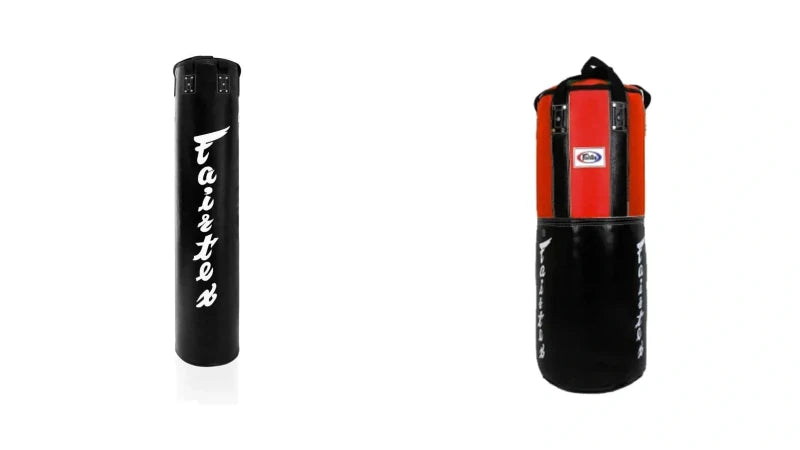
A banana bag gives you more target below the waist. A traditional heavy bag gives you a more compact target for punch-focused work.
That is the core difference. The shape does not teach technique, create power or make one bag universally more durable. It changes where you can strike, how the bag occupies the room and how it tends to move once filled and hung.
Banana bag vs heavy bag at a glance
| Question | Banana bag | Traditional heavy bag |
|---|---|---|
| Best fit | Muay Thai, kickboxing and mixed-height combinations | Boxing, punch combinations and general striking |
| Striking area | Long target that can extend toward the floor | Shorter target concentrated around head and body level |
| Low kicks | Natural fit | Possible only if the bag hangs low enough and the shell extends into the target zone |
| Room requirement | More vertical clearance | Usually easier under a lower ceiling |
| Best reason to choose it | You regularly train kicks, knees and punches on one station | Your work is mainly boxing or you need a shorter general-purpose bag |
What is a banana bag?
A banana bag is a long cylindrical hanging bag built to present striking surface from high targets down toward the legs. The current Fairtex HB6, for example, is a six-foot unfilled model made for full-length striking work.
Its length is useful for combinations such as jab, cross, body kick and low kick without changing equipment. It also lets you place knees at different heights.
But long does not mean compact. The bag may use little floor space while hanging still, yet it needs enough ceiling height for the bag and its straps, plus room for swing and the person moving around it.
What is a traditional heavy bag?
A traditional heavy bag is a shorter cylinder with its main target around head and torso height. It is the familiar choice for jabs, crosses, hooks, body shots, defensive movement and power combinations.
A compact model such as the Fairtex HB2 makes sense when punch work is the priority or the room cannot take a six-foot bag. The shorter shell does not make it “boxing only,” but it gives you less low target to work with.
Which feels better for punches?
Neither shape guarantees a better punch feel. Final weight, fill density, diameter, hanging length and mount all affect resistance and swing.
A traditional heavy bag concentrates the target where most boxing combinations land. That can make the session feel more natural for pure boxing. A banana bag still takes punches, but its extra length exists for the techniques below them.
Which is better for low kicks and knees?
The banana bag wins this comparison because the target continues toward the floor. You do not need to kick at empty air below a short shell or hang a conventional bag so low that its punch target becomes awkward.
Shape alone does not fix distance or technique. You still need coaching, controlled progression and correct placement. The bag only gives you the target.
How do they swing?
Do not assume all banana bags swing less or all heavy bags swing more. Movement changes with:
- finished weight and fill distribution
- bag length and diameter
- the length and type of straps or chains
- whether a swivel or spring is used
- the height and angle of the strike
- the mounting system
If you want a steadier target, follow the manufacturer's fill instructions and install the correct system. Do not add a solid sand core or improvised floor anchor unless the product specifically supports it.
Space and mounting
Measure from the mounting point to the floor, then subtract the complete hanging system and desired floor gap. That tells you whether the bag physically fits.
Next, map the swing path and your footwork. A long bag in a narrow room may hit the floor, wall or stored equipment once it starts moving. A shorter bag can be easier vertically but still needs lateral clearance.
Use the home punching bag installation guide before choosing hardware. If the room itself is the problem, the small-space bag guide covers neighbours, floor vibration and storage.
Which bag should you buy?
Choose a banana bag if:
- Muay Thai or kickboxing is your main discipline
- low kicks and knees appear in most bag rounds
- your ceiling height and mounting setup fit the complete bag
- you want one long target for mixed-height combinations
Choose a traditional heavy bag if:
- boxing is your main discipline
- most rounds focus on punches, angles and movement
- you need a shorter target
- you want a general-purpose first bag and rarely train low kicks
Do you need both?
Most home gyms do not. Start with the bag that matches most of your training. Add a specialist shape only when you can name the drills your first bag cannot support.
Compare the full live range in the MMA Warehouse punching bag collection, or use the heavy bag buying guide if you still need to choose between formats.
How the same round changes on each bag
Picture a simple four-part round: jab-cross, left hook, rear body kick, then a low kick after the bag returns. On a banana bag, every strike has a clear surface. You can keep the same stance and work from head height down to the leg without stopping to reset the target.
On a traditional heavy bag, the punches and body kick still work. The low kick depends on where the bottom of the bag hangs. If the shell ends near waist height, you either kick below the bag or lower the whole setup and compromise the punching zone. That is not a defect in the heavy bag. It is a sign that the round and the equipment want different things.
Now change the round to jab-cross-hook, step around, repeat. The extra lower surface of the banana bag adds little. A shorter cylinder may be easier to place at the right punching height, and its more compact shape may suit a boxing-led room better.
Shape is only the first filter
After choosing the target shape, compare the exact shell, diameter, supplied straps, fill state and finished setup. An evenly packed unfilled bag can give useful resistance; a rushed fill can leave soft shoulders, a dense bottom and hard pockets. A shorter bag can still swing heavily when it is packed dense and hung on a long system. A long bag can feel controlled when its weight, straps and mount are well matched.
This is why two people can disagree about “banana bag feel” and both be describing their own setups honestly. They may be training on different diameters, fills and hanging lengths.
A practical first-bag decision
If at least half your bag rounds include low kicks or knees, start with the long target and confirm the room can take it. If most rounds are boxing combinations with only occasional kicks, a traditional heavy bag is usually the cleaner first purchase. If you are unsure, write down the last three bag sessions you actually trained. Buy for those rounds, not for the version of your training you imagine six months from now.
Frequently asked questions
Can you box on a banana bag?
Yes. A banana bag supports standard punch combinations. Its extra value is the lower striking surface, so a pure boxer may not need the added length.
Is a banana bag better for MMA?
It can be useful for mixed-height striking, especially kicks and knees. It does not replace grappling equipment or create a complete MMA station by itself.
Are banana bags harder to install?
The mounting principles are similar, but the longer shell creates a stricter vertical measurement. Check the complete hanging length before ordering.
Which bag lasts longer?
Shape alone does not decide lifespan. Shell material, seams, lining, fill, mounting, environment, use and care all matter. Compare the exact products rather than treating “banana” or “heavy” as a quality grade.