


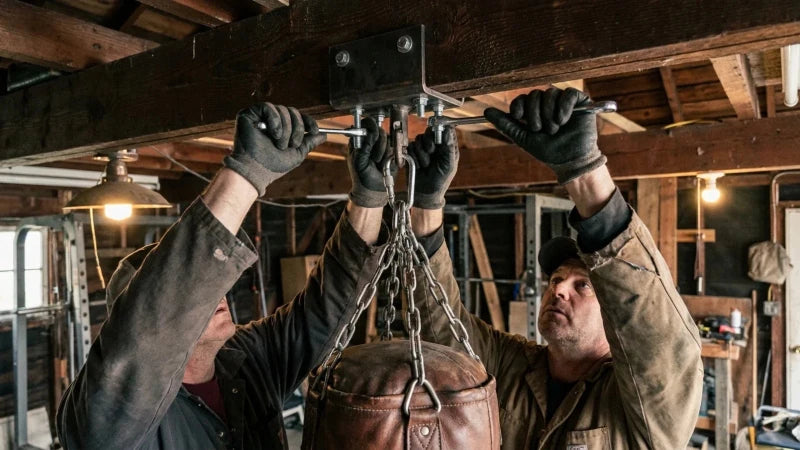
A punching bag does not create a steady downward load. Every strike makes the bag swing, twist and pull on the mount. That is why a hook that can hold the bag while it is still may not be suitable once training starts.
The safe installation process is: identify the exact bag and mounting system, verify the building structure, follow both manufacturers' instructions, then inspect the complete setup before every hard session.
Punching bag installation checklist
- Confirm the bag's filled weight, length and supplied straps or chains.
- Read the bag and mount manuals before buying hardware.
- Choose a location with enough vertical and lateral clearance.
- Identify a suitable structural member or approved masonry surface.
- Confirm the mount and every connector are compatible with the complete system.
- Install exactly to the manufacturer's instructions.
- Check the mount, connections, swing path and surrounding room before striking the bag.
- Begin with controlled strikes and stop if anything shifts, creaks, loosens or cracks.
Choose the location first
Measure the complete hanging system, not only the bag. Include the mount, spring or swivel, straps or chains and the clearance you want below the bag.
Then map the swing path. Move anything breakable or sharp out of that zone. Check doors, garage tracks, lights, windows, shelves, vehicles and other people using the room.
You also need room for your own stance and footwork. A bag squeezed into a corner may physically fit but still be useless for training.
Working with a compact room? Read the small-space punching bag guide before committing to a mount.
Pick the mounting method
Ceiling or exposed-beam mount
This setup can give the bag open movement, but only when the mount attaches to a structural member that is suitable for the repeated dynamic load. A finished ceiling surface is not a structural member.
Do not guess joist size, condition, direction or capacity from a stud-finder signal alone. Building materials, spans, existing holes, water damage and the exact mount all matter.
Wall mount
A wall bracket can move the bag away from the ceiling and limit the swing to one side of the room. It still needs a structure or masonry surface approved for the bracket. Drywall, plaster and cladding do not carry the bag by themselves.
Follow the bracket manufacturer's spacing, fastener and substrate requirements. Do not substitute hardware because it “looks close.”
Freestanding bag
A freestanding bag avoids drilling into the building. It does not eliminate setup questions: the base needs a level floor, the specified fill and enough room to move without hitting furniture or walls.
Compare the tradeoffs in our freestanding versus hanging bag guide.
Tools and hardware
Your exact list comes from the mount instructions and the material you are attaching it to. A typical installation may require measuring tools, a level, a detector suitable for the wall or ceiling, a drill and bits matched to the specified fasteners, hand tools and eye protection.
Do not copy bolt sizes, torque settings, anchor types or load ratings from a generic article. Those details must come from the mount manufacturer and, where needed, a builder, engineer or qualified installer who knows the structure.
Installation sequence
1. Lay out the complete system
Check that the bag, mount, straps or chains, swivel, spring and connectors are compatible. Inspect all parts for damage and confirm that no required hardware is missing.
2. Mark the bag position
Use the bag length and the supplied hanging components to set the striking height. The useful target zone should match the people and techniques the bag is intended for.
3. Verify the structure
Expose or positively identify the mounting substrate as required by the installation instructions. If you cannot verify it, stop. A professional visit costs less than a failed ceiling or injured training partner.
4. Install the mount
Follow the mount manual in full. Use only the specified fastener type, diameter, length, spacing and installation method for the confirmed substrate. Do not mix instructions from different mounts.
5. Attach the bag
Use compatible, undamaged connectors. Close every locking mechanism. Make sure straps and chains are not twisted and cannot rub against a sharp edge.
Test before hard training
A DIY “load test” cannot certify a structure, and pulling on the bracket by hand does not reproduce repeated striking forces. Treat testing as a final inspection, not proof that a questionable mount is safe.
- Check that the mount sits flush and has not shifted.
- Confirm every connector is fully closed.
- Move the bag gently through its expected path.
- Listen and watch for movement, cracking, creaking or fasteners backing out.
- Start with light, controlled strikes.
- Stop immediately if the structure, mount or connectors move or make new noise.
Inspect the setup regularly
Before training, look at the bag's straps or D-rings, every connector, the mount and the surrounding structure. After the first sessions, recheck the installation as directed by the manufacturer.
Do not keep training on rusted, bent, cracked, frayed, loose or partly detached components. Replace them with compatible parts and investigate why the damage appeared.
The punching bag maintenance guide covers the shell and attachment-point checks in more detail.
Common installation mistakes
- Mounting into the finished surface instead of verified structure
- Choosing hardware by bag weight alone
- Ignoring the force created by swing and rotation
- Measuring the bag but forgetting the mount and straps
- Using open or incompatible connectors
- Placing the bag near glass, lights, doors or stored items
- Continuing to train after a new noise or visible movement appears
Plan the bag height around the work
There is no single mounting height for every bag. A compact boxing bag needs its main striking zone around the punches you train. A banana bag needs enough room to present low-kick targets without dragging on the floor. A teardrop bag needs its angled surface where knees and uppercuts can reach it safely.
Set the height with the complete assembly laid out on the floor. Include the mount, spring or swivel, straps and connectors. If the adjustment range cannot put the useful part of the bag where you need it, change the hardware plan or bag before drilling.
Room-specific checks people miss
Garage
Open and close the garage door before marking the position. Check vehicle height, tracks, openers, storage racks and seasonal condensation. The empty bay you measured may not be the room you use every day.
Basement
Low ceilings can make a long bag impossible even when the floor area looks generous. Pipes, ducting and electrical runs are not mounting members. Damp also changes the storage and cleaning plan.
Rental or finished room
Obtain permission before structural work. A neat patch later does not erase unauthorized drilling, and a detector reading does not tell you the condition or capacity of the hidden structure.
What a professional handoff should include
Give the installer the exact bag, expected filled weight, supplied hanging components, mount instructions and intended location. Ask them to verify the substrate and use the specified fasteners. “Install a boxing bag somewhere here” leaves too many decisions unstated.
Once the station is complete, keep the manuals and product information with your maintenance records. If a connector or strap needs replacement later, you want the compatibility answer—not a visually similar piece from a hardware bin.
Frequently asked questions
How high should I hang a punching bag?
Set the height from the useful striking zone, bag length and supplied hanging system. A punch-focused bag and a six-foot banana bag should not be positioned by the same generic number.
Can I hang a punching bag from drywall?
No. Drywall is a finished surface, not a structural mounting point. The mount must attach to a suitable verified structure or approved masonry substrate according to its instructions.
How much clearance does a punching bag need?
Enough for the full expected swing plus your stance, steps and combinations, with no contact with walls, lights, windows, doors or stored equipment. Measure the actual setup rather than relying on one universal radius.
Do I need a professional installer?
Use one whenever the structural member, substrate, fastener choice or mount compatibility is uncertain. Renters should also obtain any required property approval before drilling.
Where can I compare current bag sizes?
Start with the heavy bag buying guide, then verify every dimension and fill detail on the live punching bag collection and product page.