


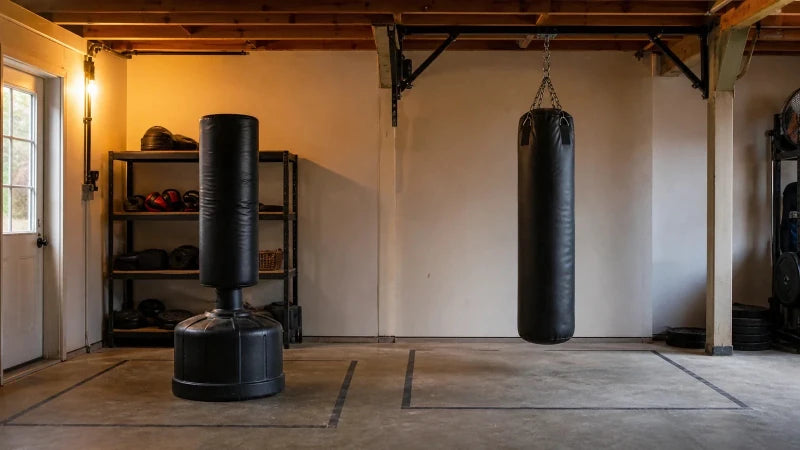
Choose a hanging bag when strike feedback, power work and movement around the target matter most. Choose a freestanding bag when you cannot install a structural mount or need the setup to be movable.
The catch: freestanding does not mean space-saving, and hanging does not mean complicated if you already have a suitable structure. Measure the room before you buy.
For the full decision tree by sport and bag shape, start with our heavy bag buying guide.
Freestanding vs hanging at a glance
| Factor | Freestanding bag | Hanging bag |
|---|---|---|
| Installation | No ceiling or wall mount; base must be filled | Needs a suitable structural mount and hardware |
| Strike feedback | Depends heavily on base and stem; can rock or walk | Usually more natural swing and firmer resistance |
| Power work | Fine for controlled work; hard shots may move the base | Usually the better choice when the mount and bag are properly matched |
| Floor space | Base permanently occupies the footprint | Floor below can be clear when the bag is tied back or removed |
| Noise | No chain noise, but base movement can transmit through the floor | Straps can be quiet; chains, swivels and structure can transmit vibration |
| Moving or storage | Movable only after dealing with a heavy filled base | Bag can be unhooked, but the mount remains |
Where a hanging bag is better
A hanging bag gives you a target that swings from the top. That movement rewards distance control, angles and resetting your feet. A sufficiently heavy bag also stays useful when you increase power.
Hanging bags come in more useful striking shapes: compact cylinders for boxing, long banana bags for low kicks, and teardrops or angled bags for uppercuts and knees. Browse the current punching bag range only after deciding which shape your training needs.
The limitation is structural. A heavy bag creates dynamic load, not just static weight. The building structure and hardware must be suitable. If that is uncertain, stop and use a qualified installer rather than guessing from the bag's listed weight.
Where a freestanding bag is better
A freestanding bag avoids drilling into a ceiling or wall. That makes sense in rentals, multipurpose rooms and spaces where the structure is unknown.
It can also be repositioned, but “portable” is relative. A properly filled base is heavy. Moving it across a room may be manageable; carrying it between floors is a different job.
Base design matters. Some freestanding bags are built for quick boxing combinations, some provide a low-kick target, and some are closer to reflex trainers. Do not assume every freestanding model can replace a full-length hanging bag.
Which takes less space?
Neither wins automatically.
- A freestanding bag needs room for the base, the striking column and your stance around it.
- A hanging bag needs a swing zone and safe clearance from walls, glass, lights and stored equipment.
- A hanging bag can free the floor when removed or tied back.
- A freestanding bag may be easier to park in a corner, but the base still has to live somewhere.
Use the room-planning steps in our small-space punching bag guide before trusting a product photo.
Noise: what neighbours actually hear
Hanging hardware can clank, while wall and ceiling mounts can carry vibration into the structure. Nylon straps, a suitable swivel and correct installation can reduce some of that noise.
Freestanding bags avoid chains, but a rocking base can thump against the floor. A stable surface and appropriate mat help, but no striking setup is silent.
Choose by training, not convenience alone
| Your situation | Better starting point |
|---|---|
| You box hard and want realistic bag movement | Hanging heavy bag |
| You train Muay Thai with regular low kicks | Long hanging bag, unless a specific freestanding model provides a stable low target |
| You rent and cannot drill | Freestanding bag |
| You need the room for other uses | Removable hanging bag or a freestanding unit you can genuinely move |
| You do not know whether the ceiling can support a bag | Freestanding bag until the structure is professionally assessed |
Before you buy
- Mark the full base or swing footprint on the floor.
- Stand in your actual fighting stance and move around the marked zone.
- Check ceiling height, doors, lights, windows and vehicle clearance.
- Decide where the equipment will live between sessions.
- If hanging, follow the punching bag installation guide and verify the structure.
What the movement feels like in practice
A hanging bag moves from its suspension point. When you strike off-center, it can swing, turn and return on an arc. That gives you a reason to adjust distance and step around it, but it also means you need enough room to let the bag move without colliding with the room.
A freestanding bag pivots or flexes above a weighted base. Some models rebound quickly; others rock, slide or slowly rotate. You can still practise clean combinations, but the feedback is model-specific. A base that walks across the floor after every hard kick changes the round from striking practice into equipment management.
Choose from the building outward
Rental apartment
If drilling is prohibited, a freestanding bag is the obvious shortlist. Mark the full base on the floor, test the likely noise path and decide how the filled base will move when the room is needed for something else. “No installation” does not mean “no consequences.”
Garage with exposed structure
A hanging bag may be the better training tool, but an exposed member is not automatically an approved mounting point. Confirm the structure, keep clear of the garage door path and account for moisture and temperature.
Dedicated gym room
A hanging station usually makes sense when the structure and clearance are available. A freestanding bag still earns a place when mobility or a specific rebound is useful, not merely because it is easier to assemble.
The decision you should be able to explain
Before checkout, finish this sentence: “I chose this format because my room cannot support ___, and my main rounds need ___.” If the answer is only “it had better reviews,” measure the room again.
Frequently asked questions
Can you hit a freestanding bag hard?
Yes, within the design limits of the model. Hard strikes may make the base rock, slide or rotate, so choose a unit built for your intensity and set it up exactly as instructed.
Is a hanging bag better for beginners?
Not automatically. Beginners benefit from stable, correctly positioned equipment and coaching. A freestanding bag may be more practical; a hanging bag may give clearer distance and swing feedback.
Can a hanging bag work in an apartment?
Sometimes, but structure-borne vibration and installation permission are major constraints. A freestanding bag can be easier to approve, though floor noise still matters.
Which is better for low kicks?
A long hanging banana bag is the safer general recommendation. Some freestanding bags support low kicks, but the striking surface and base must be designed for them.