

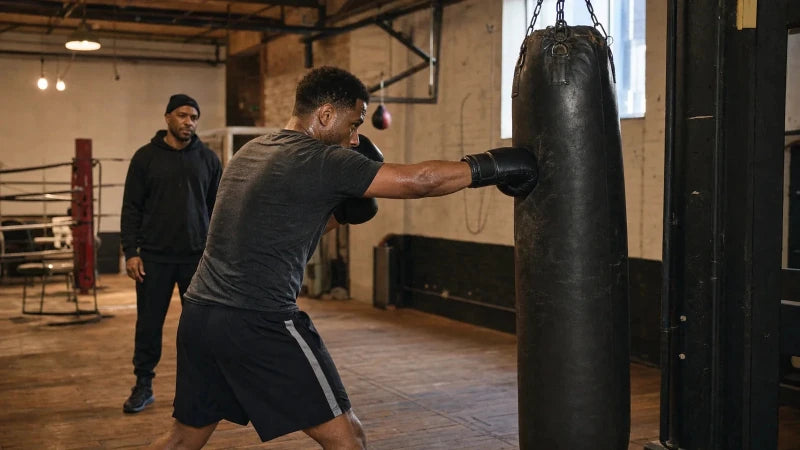
A good heavy bag session is not thirty minutes of hitting as hard as possible. Give every round one job, keep the technique clean, and stop the round before fatigue turns punches into shoves.
Below are three complete sessions: one for beginners, one for technical development and one for conditioning. Adjust round length and rest to your experience and your coach's plan.
If you still need the bag itself, use our heavy bag buying guide before copying a workout built for the wrong target.
Before the timer starts
- Check the mount, straps, stitching and floor area.
- Use hand wraps and suitable bag gloves for punching rounds.
- Warm up with easy movement, shoulder rotations and light shadowboxing.
- Set a pace you can hold without losing stance, guard or balance.
- If you are new to striking, learn the mechanics with a qualified coach before adding power.
Our installation guide covers the equipment check. For glove choice, see the boxing and Muay Thai glove guide.
Workout 1: beginner control session
Format: six 2-minute rounds with 60 seconds rest. Work at a pace that lets every punch return to guard.
| Round | Job | Main cue |
|---|---|---|
| 1 | Jab only | Touch the bag, recover the hand and reset your stance |
| 2 | Jab-cross | Turn the hips without falling through the target |
| 3 | Jab-cross, step out | Finish the combination somewhere safer |
| 4 | Jab to body, cross to head | Change level with the legs, not by folding at the waist |
| 5 | Any clean two-punch combination | Accuracy before speed |
| 6 | Free technical round | Stay relaxed and keep moving after every exchange |
Do not chase the bag. Let it return, step to the correct range, then work again.
Workout 2: technique and footwork
Format: five 3-minute rounds with 60 seconds rest. Keep power moderate. The aim is to leave each exchange balanced.
- Entry round: jab from outside range, step in behind it, then step out.
- Angle round: finish every combination with a pivot or lateral step.
- Body-head round: alternate levels without telegraphing the change.
- Defence-after-offence round: finish with a slip, roll, frame or exit your coach uses.
- Open round: combine the previous jobs without abandoning form.
The bag is not an opponent, so do not pretend its swing proves a defence worked. Use the movement as a timing cue, then return to stance and position.
Workout 3: controlled power and conditioning
Format: six 3-minute rounds with 60 to 90 seconds rest. This is for athletes who can already maintain technique under fatigue.
| Round | Structure |
|---|---|
| 1 | Steady combinations at conversational effort |
| 2 | Every 20 seconds, add one clean power shot; return to steady work |
| 3 | Three-punch combinations, then circle to a new angle |
| 4 | 10 seconds fast, 20 seconds controlled, repeated for the round |
| 5 | Body-focused combinations at moderate power |
| 6 | Open round with the last 20 seconds faster only if form is intact |
Muay Thai and kickboxing variation
Use a long bag if the session includes low kicks. Replace selected boxing combinations with simple, coached sequences such as jab-cross-low kick, cross-hook-body kick or knee entries.
Do not add every weapon to every round. One round of clean kick setup is more useful than a random mix of punches, kicks, knees and elbows with no positioning.
How to progress without a fake formula
There is no reliable fixed weekly percentage for power progression. Progress one variable at a time:
- Add one round while keeping the same quality.
- Keep the rounds and reduce rest slightly.
- Use a more complex combination without increasing speed.
- Increase speed while keeping power moderate.
- Add selected power shots while the rest of the round stays controlled.
If technique breaks, the progression is too aggressive. Go back one step. If your current target is the limitation, compare the current punching bag range by shape and intended use.
Common heavy bag mistakes
- Pushing the bag: strikes should land and recover, not lean through the target.
- Holding your breath: exhale with strikes and keep the shoulders loose.
- Standing square after combinations: finish in stance and move.
- Throwing while the bag is out of range: use footwork instead of reaching.
- Making every round hard: technical rounds need enough control to notice errors.
- Training through pain: stop and get appropriate coaching or medical advice rather than changing mechanics around it.
Four drills worth repeating
One-two, exit, re-enter
Throw a clean jab-cross, take one purposeful exit step, then return behind the jab. The round is not about volume. It is about finishing the cross without leaving your feet behind and entering again from a balanced stance.
Body-head decision round
Start every exchange with the jab. If the bag is moving toward you, hold your ground or step off and finish to the head. If it is moving away, step with it and finish to the body without reaching. The bag is only a timing cue, but the decision keeps the round from becoming memorized choreography.
Three levels on a long bag
For Muay Thai or kickboxing, build a simple sequence across head, body and leg targets: jab-cross, body kick, reset, then low kick after a new entry. Keep the kick setup visible in the round. Do not throw isolated power kicks every time the lower target appears.
Accuracy under fatigue
Mark or imagine two small target zones. Work controlled combinations for 40 seconds, then a 10-second faster burst, then spend the final 10 seconds returning to exact placement. If the targets disappear as speed rises, the drill has shown you the limit.
Build a week without making every day hard
A useful bag week can have three different purposes. One session is technical: moderate pace, precise targets and plenty of footwork. One is physical: structured intervals that challenge breathing without losing stance. One is power-led: fewer hard shots, longer recovery and strict hand protection.
Those sessions can be shorter or longer depending on the rest of your training. The separation matters more than a universal schedule. If sparring, pads and strength work are already demanding, another hard bag day may add fatigue without adding skill.
How to review a round
After each round, name one thing that held up and one thing that failed. “Cardio was bad” is too broad. “My rear heel stayed planted on the last hook” or “I stopped exiting after combinations” gives the next round a job. Video can help when the gym permits it, but a coach's live correction is still more useful than collecting clips with no change in practice.
Frequently asked questions
How long should a heavy bag workout be?
Count useful rounds, not total clock time. A focused beginner session may be six 2-minute rounds. Experienced athletes may do more, but only while technique and recovery support it.
Should every punch be hard?
No. Most rounds should leave enough control for clean mechanics, accuracy and movement. Reserve power for specific shots or rounds.
How often should I use the heavy bag?
That depends on total training load, experience and recovery. Put bag work inside a broader coaching plan rather than adding hard sessions whenever you feel fresh.
Can I learn boxing from a heavy bag alone?
No. A bag gives resistance and a target, but it cannot correct your stance, distance, defence or timing. Coaching, partner drills and shadowboxing still matter.