


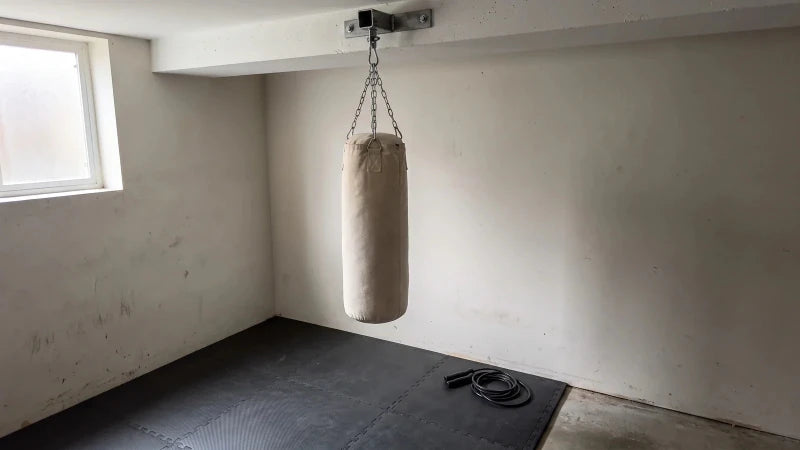
In a small room, the bag is only half the footprint. You also need space for its base or swing, your stance, your steps and the noise the setup sends into the building.
That is why the “smallest” bag is not always the best small-space bag. Start with the room and its restrictions, then choose the equipment.
Best punching bag setup by small-space constraint
| Your constraint | Best starting format | Main tradeoff |
|---|---|---|
| No permission to drill | Freestanding bag or removable training alternative | The base occupies floor space and can transmit noise. |
| Low ceiling | Short hanging bag or freestanding bag | A short target is less useful for repeated low kicks. |
| Very limited floor space | Wall-mounted pad or compact hanging bag | Requires a verified structure and limits movement around the target. |
| Apartment neighbours | Quiet technique work, pads with a partner or a carefully tested freestanding setup | No heavy bag is guaranteed to be quiet in every building. |
| Need the room back after training | Movable freestanding setup or equipment designed for removal | Heavy bases are not easy to move when filled. |
Measure the training zone, not the product photo
Use tape on the floor to mark the base or hanging point. Then stand in your fighting stance and move through the combinations you plan to train.
Check:
- your lead and rear steps
- the bag's likely movement after impact
- doors, windows, lights, shelves and furniture
- garage tracks or vehicles
- the full hanging length from mount to floor
- where gloves, wraps and the bag will go after training
There is no useful universal “small room” clearance. A compact punch drill needs less movement than a round built around circling and low kicks.
Freestanding bags: convenient, not invisible
A freestanding bag avoids ceiling or wall installation. That makes it attractive for renters and shared rooms.
The base is the catch. Measure it at its widest point, leave space for any rocking or movement, and consider how you will fill, empty and move it. A full base may be far harder to relocate than the product photo suggests.
Floor mats can protect the surface and may change vibration, but they do not guarantee that downstairs or adjoining neighbours will not hear the session.
Compact hanging bags: more floor space, more installation
A short hanging bag keeps the floor clear when it is not in use. The live Fairtex HB2, for example, has a compact three-foot body intended for focused punch work.
But the mount must attach to a suitable verified structure. The bag also needs a swing path. If you cannot identify the mounting substrate or obtain property approval, this is not the shortcut it appears to be.
Read the punching bag installation guide before choosing a ceiling or wall system.
Wall-mounted targets
A fixed wall target uses very little floor area and can work for straight punches, hooks, uppercuts or body-shot drills depending on its shape.
It does not reproduce a swinging bag, and the wall still needs to support the exact product and installation. It is a focused station, not a complete replacement for every bag round.
Doorway bags and improvised mounts
Treat generic doorway claims with caution. Door frames, trim and tension bars vary, and a repeated striking load is not the same as hanging clothes or doing a controlled pull-up.
Use a doorway product only when the manufacturer explicitly approves the exact installation and the frame meets every requirement. Do not hang a heavy bag from an improvised tension rod.
Noise and neighbours
Bag noise is more than glove-on-shell sound. A hanging mount can transmit vibration through framing. A freestanding base can thump or scrape across the floor. Chains, swivels and springs can add their own noise.
Before buying:
- check lease, strata, building and household rules
- avoid training against shared sleeping or working walls
- test at the times you will actually train
- use controlled technique rounds before hard power work
- stop if the bag, base or room starts moving in ways the product does not allow
If quiet use is non-negotiable, hand pads with a partner, shadowboxing, resistance work or a smaller technique target may be a better answer than forcing a heavy bag into the room.
Which current bag makes sense?
For low-ceiling punch work, compare the compact Fairtex HB2. For Muay Thai, the six-foot Fairtex HB6 gives much more low-kick target, but its length makes it the harder small-room fit.
Use the live punching bag collection to check current dimensions and availability. Then use our heavy bag buying guide to compare shapes and fill, or jump to the punching bag picks by space and training style for the current shortlist.
Small-space buying checklist
- Get permission for any permanent mount.
- Measure the complete product, base or hanging system.
- Mark your stance and movement on the floor.
- Identify the noise path to nearby rooms and neighbours.
- Plan where the equipment goes after training.
- Verify current product instructions and availability.
- Choose a different format if any structural or neighbour constraint remains unsolved.
Three small rooms, three different answers
Apartment living room
The room may be wide enough while the building is still wrong for a heavy bag. If you cannot drill and the downstairs neighbour hears footwork, a freestanding bag may only move the problem into the floor. Start with quiet technique work and test any equipment at the hours you will use it.
Single-car garage
A compact hanging bag can work when it clears the door, car and storage path. Mark the training footprint with the car parked, not while the bay is empty. A removable bag is useful only if you can safely lift and store it after training.
Spare bedroom
A wall target can preserve more floor area than a base, but it narrows the drills and still needs a verified structure. If the room also contains a desk or bed, measure the usable stance after furniture, not the nominal room dimensions.
Compact product does not mean compact training
The Fairtex HB2 shortens the hanging target, which helps under a lower ceiling. It still swings and still needs footwork space. The Fairtex HB6 uses little floor area while still, but its six-foot body and full-height kick work ask more from the vertical and movement envelope.
Compare the dimensions that remain after installation: widest base, complete hanging length, expected swing and the human moving around it. That is the real footprint.
When the best bag is no bag
If the setup cannot be mounted, moved or used without disturbing the building, forcing a bag into the room is not resourceful. Shadowboxing, partner pads in an approved space and strength or conditioning work can keep training productive until the room changes.
Frequently asked questions
What is the best punching bag for an apartment?
There is no apartment-safe universal pick. A freestanding bag avoids drilling, but the base can still create floor noise. Choose only after checking the lease, floor construction, available footprint and neighbour impact.
Can I put a punching bag in a bedroom?
Only if the room provides a safe movement zone, the floor or mount supports the exact setup, and the noise is acceptable. Keep the bag away from glass, lights, furniture and sleeping areas.
Can I hang a bag from a door frame?
Not unless a purpose-built product explicitly approves the exact frame and installation. Do not improvise a heavy-bag mount from a tension bar.
Is a smaller bag always quieter?
No. Noise depends on the mount, floor, base, connectors, bag movement, strike force and the building. A smaller product can still transmit sharp vibration.