


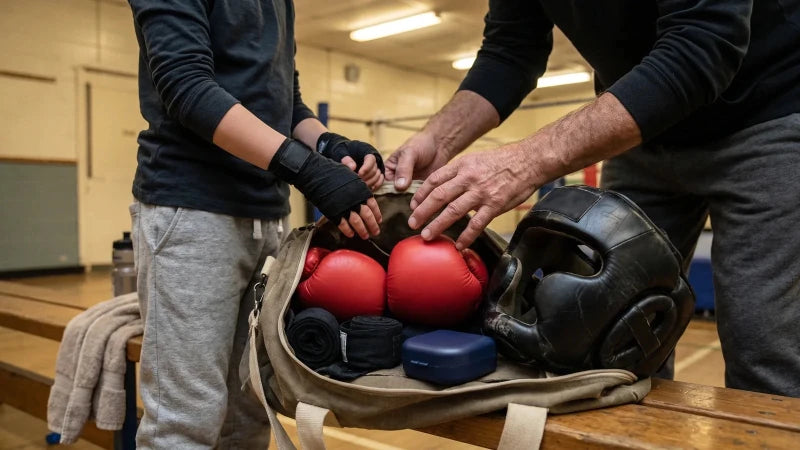
For a child’s first combat-sports class, the correct shopping list comes from the coach—not a universal online bundle.
Ask what the gym provides, which glove or uniform the class uses, and whether partner contact is part of the session. Then buy the smallest set of personal gear that fits correctly today. Use the boxing, Muay Thai, MMA and BJJ gear checklist for the adult category map, and the combat-sport gear guide by discipline for clothing and accessory context.
Start with the class requirement
| Class | Common personal items | Confirm before buying |
|---|---|---|
| Youth boxing | Hand wraps, mouthguard and class-specified gloves | Glove weight, headgear policy and when partner drills begin |
| Youth Muay Thai or kickboxing | Wraps, mouthguard and gloves | Shin-guard type, groin or chest protection and contact rules |
| Youth MMA | Mouthguard and fitted training clothing | Whether the class uses boxing gloves, MMA gloves, shin guards or no contact |
| Youth BJJ | Academy-approved gi or no-gi kit | Colour, patches, rash guard, mouthguard and competition rules |
Do not assume adult equipment in the smallest label will fit a child. Youth gloves, headgear and guards should be checked in movement, not only while standing still.
Fit checks for youth gear
Gloves and wraps
Choose the glove for the coach’s drill and check it over the wraps the child will wear. The hand should not slide inside, but the glove must not cause numbness or pressure. Our kids’ boxing-glove sizing guide and kids’ MMA glove guide cover the two different categories.
Mouthguard
A mouthguard should stay in place without constant biting and should allow normal breathing and speech. Follow the manufacturer’s fitting directions. Braces, changing teeth and dental work can change the decision; ask the child’s dentist when needed. The combat-sport mouthguard guide covers types, fit and replacement signs.
Headgear
Headgear should remain centered when the child looks, moves and changes level. Vision cannot be blocked. It may help reduce facial cuts, but it should not be presented as concussion protection. The headgear guide explains that boundary.
Shin guards and body protection
The shin pad should stay over the shin and the instep over the top of the foot. Straps should not restrict circulation. Groin or chest protection must match the child, the activity and the gym’s policy.
Protection is not permission for harder contact
Protective equipment manages specific contact; it does not make uncontrolled sparring appropriate. Coaching, age-appropriate rules, partner matching and intensity control do more work than any label on a piece of gear.
The Association of Ringside Physicians says headguards should not be relied on to reduce concussion or traumatic-brain-injury risk. The American Dental Association says properly fitted mouthguards reduce the incidence and severity of oral injury, while evidence for concussion reduction is mixed.
Competition gear is a separate check
Event rules can vary by age, category and sanctioning body. The current World Boxing rules, for example, distinguish headguard requirements by age and category. That does not create a universal rule for every boxing, kickboxing or MMA event.
Get the current event packet and let the coach confirm the exact equipment before ordering. “Competition style” on a product page is not the same as approval for a specific event.
Do not buy years of growing room
Oversized gear can rotate, obscure vision or change how the child moves. Fit the athlete now and recheck during growth spurts. Replace or resize when closures stop securing the item, coverage shifts, padding deforms or the child reports pain, tingling or restricted movement.
Keep youth gear clean
- Label personal items and do not share mouthguards, wraps or towels.
- Wash and fully dry wraps and training clothing after use.
- Wipe non-washable gear with a material-compatible cleaner and air it out.
- Cover cuts and keep an athlete with a draining skin lesion off shared mats until medically cleared.
The CDC’s athlete guidance supports cleaning personal gear, washing and drying clothing after use, showering after exercise and not sharing personal items. Use the full care checklist between sessions.
A sensible first purchase
- Get the coach’s written class list.
- Buy the required personal-contact items.
- Fit every item in movement.
- Delay specialist pads and competition gear until the program needs them.
- Recheck fit as the child grows.
When the coach has confirmed the category, compare current boxing and Muay Thai gloves, shin guards and headgear.
Questions every parent should ask the coach
- What exact equipment is required for the first four weeks?
- Does the gym lend gloves or guards for a trial class?
- What glove weight and style are used for bag work and partner work?
- When do children begin contact drills, if at all?
- Which items must the child own and which are supplied?
- Are there event-specific colours, uniforms or approved models on the horizon?
Get the answer in writing when possible. “Boxing gloves” is not precise enough if the class uses one weight for bags and another for controlled sparring. “Headgear required” is not precise enough if the coach expects a particular coverage style.
Fit a moving child, not a size label
Have the child make a fist, raise both hands, turn the head, squat, lunge, check a kick and move through a light stance. Ask what they feel instead of only asking whether it is comfortable. Pressure at one finger, a guard touching the kneecap or headgear falling toward the eyes can be easier for a child to point out than to describe.
Recheck after several classes. New equipment settles, wraps change glove volume and a child may report problems only after moving at normal speed. Any numbness, tingling, blocked vision or equipment rotation means stop and refit.
Should siblings share equipment?
Clothing can be handed down when it is clean, structurally sound and fits the younger athlete now. Protective equipment needs a stricter check: closures must hold, padding must be even, the size must match and the current gym must accept it. Mouthguards should never be shared. Wraps are cheap enough and personal enough to keep separate.
A hand-me-down that does not fit is not free; it is the wrong equipment. Growth room should come from an adjustable product designed to remain stable across that range, not from buying a loose adult item and tightening it until it stops falling off.
Parent buying order
- Confirm the class and contact level.
- Buy the personal hygiene and uniform items.
- Choose the coach-specified glove and test it with wraps.
- Add shin guards or headgear only when the training format requires them.
- Recheck size during growth spurts and before every competition.
Sources and rule checks
- Association of Ringside Physicians headguard position statement: Headguards should not be relied on to reduce concussion or traumatic-brain-injury risk.
- American Dental Association mouthguard guidance: Properly fitted mouthguards reduce the incidence and severity of oral injury; concussion evidence is mixed.
- CDC guidance for athletes: Clean personal gear, wash and dry clothing after use, shower after exercise, and do not share personal items.
- World Boxing Competition Rules: Competition equipment, hand-wrap and headguard requirements vary by age and event category.