


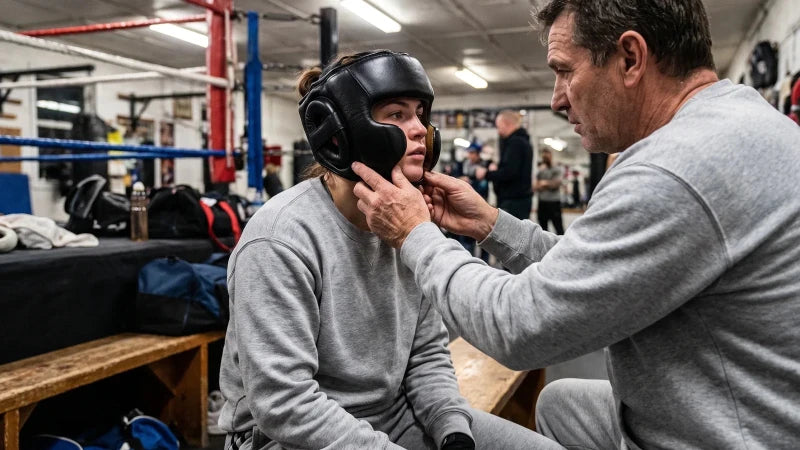
Boxing headgear is mainly a cut, bruise and contact-management decision. It should not be sold as a concussion shield.
Choose by training format, face coverage, visibility and fit. Then check the gym or event rule. A bulky “maximum coverage” model is not automatically the safest choice if it shifts, blocks your eyes or makes you miss incoming shots. For the rest of the kit around it, use the combat-sport protective gear checklist.
Choose the coverage style first
| Style | What it covers | Main tradeoff | Common use |
|---|---|---|---|
| Open face | Forehead, temples, cheeks and ears vary by model | Best sight lines; less nose and cheek coverage | Technical boxing and striking work |
| Cheek protector | Adds raised cheek coverage | More facial coverage with some loss of lower peripheral vision | General sparring |
| Full face or nose bar | Adds a bar or broader front protection | More bulk and a larger visual obstruction | Specific gym use, injury return only with medical clearance |
| Ear guard | Outer ear rather than the face | Not a striking headguard | Wrestling and grappling |
Do not buy by category name alone. Two “cheek protector” models can sit very differently on the same face.
What headgear does not do
The Association of Ringside Physicians position statement says headguards should not be relied on to reduce concussion or other traumatic-brain-injury risk. Research supports a role in reducing some lacerations, but no padded headguard makes repeated head contact harmless.
That changes the buying question. You are not shopping for a magic impact rating. You are looking for stable fit, appropriate coverage and clear vision inside a coached sparring format.
Run this five-point fit test
- Set the brow: the front padding should sit where the maker intends without falling into your eyes.
- Secure the crown and rear: tighten evenly. Do not crank one strap to compensate for the wrong shell size.
- Close the chin: the strap should hold the headgear in place without choking or pulling the shell forward.
- Move before contact: bounce, pivot, slip and look over both shoulders. The eye opening should stay clear.
- Use light coach-controlled contact: if the headgear rotates after a touch, stop and refit.
Reject the fit if it creates pressure pain, blocks breathing, covers the eyes, slips when sweaty or leaves hardware rubbing the skin.
Visibility versus coverage
More material around the face can reduce cuts or contact to a covered area, but it can also narrow the field of view. That matters in boxing, Muay Thai and MMA, where seeing the next strike is part of defense.
Open-face designs favor sight lines. Cheek models split the difference. Full-face designs make sense only for a defined training need accepted by the coach. They are not a default upgrade.
Training rules are not competition rules
Headguard requirements change by sport, age and event. The published World Boxing competition rules, for example, distinguish youth categories and elite men’s and women’s competition. A local event may use a different rule set or approved-equipment list.
Before competition, confirm the event body, age category, color, closure and approved model. “Competition headgear” in a product title is not proof that every event will accept it.
When should you replace headgear?
Use condition, function and manufacturer guidance—not a made-up calendar. Retire or professionally assess it when:
- padding stays crushed, shifts or separates;
- straps, laces, hook-and-loop or buckles no longer hold;
- the shell tears or stitching opens near a load-bearing point;
- hard or sharp parts become exposed;
- it no longer fits after a body or hairstyle change;
- the manufacturer tells you to replace it after a specific event or impact.
Clean it using the material and maker instructions. Do not soak structured padding or use heat to speed drying unless the label explicitly allows it. See our protective-gear maintenance guide.
Headgear buying checklist
- What sport and sparring format is this for?
- Does the coach require open face, cheeks or a nose bar?
- Can you see punches and kicks from normal stance?
- Does it stay centered after movement?
- Can you return or exchange it after a clean fit test?
- Does the event require an approved model?
Browse current combat-sport headgear only after answering those questions. Pair the decision with a properly fitted mouthguard; our mouthguard guide explains the types and limits.
Current headgear routes by coverage
| Model | Coverage route | What to verify |
|---|---|---|
| Fairtex HG10 Super Sparring Headgear | A Fairtex sparring option for buyers comparing broader facial coverage. | Eye opening, cheek position and whether the shell stays centered after movement. |
| Fairtex HG13 Sparring Headgear | A lace-up Fairtex route for a buyer who deliberately prefers that adjustment system. | Whether someone can help set the rear laces consistently and whether the fit remains practical for daily use. |
| YOKKAO Training Headgear | A current YOKKAO training model for routine gym comparison. | Size chart, closure adjustment and clear peripheral vision in stance. |
| YOKKAO Competition Headgear | A competition-named option when its exact format matches the event requirement. | The event's current approved-equipment rule; the product name alone is not approval. |
The clean fit test matters for returns
Headgear is difficult to judge from measurements alone, but it is also a personal-contact product. Read the store's current return conditions before doing a fit check. Try it with clean skin and dry hair, keep every tag and package intact, and do not run a sweaty round in something you may need to exchange.
Adjust from the crown and rear before pulling the chin closure tight. The chin strap should secure an already-correct fit, not drag an oversized shell down onto the eyes. If the cheeks sit in the wrong place or the brow padding blocks vision, changing strap tension is unlikely to repair the basic geometry.
Open face, cheek protection or a bar?
Choose open face when sight lines and a lighter feel lead the decision. Choose cheek protection when you accept some additional bulk for more covered facial area. Choose a bar only for a defined reason agreed with the coach. A nose bar can change depth perception and does not make uncontrolled contact acceptable.
The best headgear is not the model with the most material. It is the permitted model that stays centered, lets you see and does not create a new problem while covering the area you intended.
Sources and rule checks
- Association of Ringside Physicians headguard position statement: Headguards should not be relied on to reduce concussion or traumatic-brain-injury risk.
- World Boxing Competition Rules: Competition equipment, hand-wrap and headguard requirements vary by age and event category.