


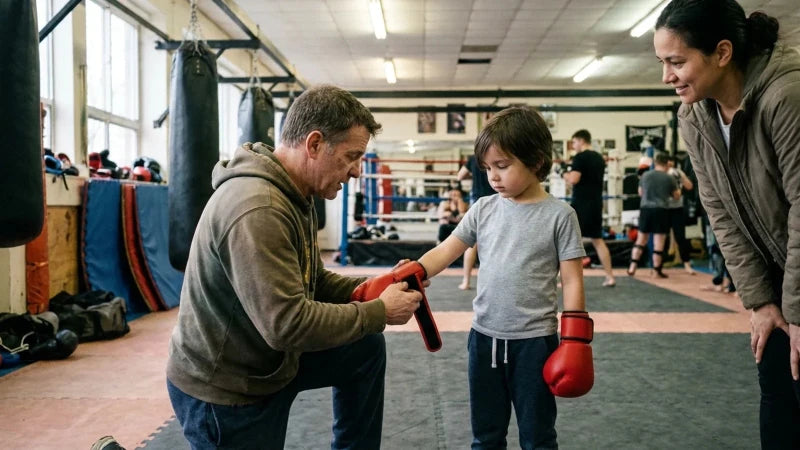
Choose kids boxing gloves in this order: class rules, coach-required weight, exact model size and wrapped-hand fit. Age and body weight can give context, but neither creates a universal glove-size chart. The child must be able to make a natural fist without numb fingers, a folded thumb or a loose wrist closure.
| Decision | Ask | Red flag |
|---|---|---|
| Training job | Is this for bags, pads, drills or sparring? | One pair is assumed to suit every session |
| Glove weight | What does the coach or event require? | An age chart overrides the gym |
| Hand fit | Does the exact model fit over normal wraps? | Numbness, pinching or a shifting hand |
| Wrist closure | Can the child secure it without help? | Large gap, slipping strap or hard edge |
| Condition | Is padding even and are seams intact? | Hard spots, exposed foam or failed closure |
Start with the class, not an age chart
A beginner boxing class, youth fitness session, bag drill and sanctioned bout can use different equipment rules. Ask the coach which glove type and ounce weight the child needs before measuring a product. Competition equipment is controlled by the sanctioning organization; the current USA Boxing rulebook hub is the primary route for USA Boxing requirements.
Do not convert “eight years old” or “70 pounds” into a guaranteed glove weight. Ounces describe total glove weight, not internal hand size. Two 8 oz gloves can fit differently, and a youth-sized hand compartment may not exist in every adult model.
How to measure a child's hand
- Measure around the widest part of the dominant hand, excluding the thumb.
- Measure from the wrist crease to the tip of the middle finger if the product chart asks for length.
- Record the wrap or inner-glove setup used in class.
- Use the size chart for the exact model, not a generic brand chart from another retailer.
- Recheck the measurements as the child grows.
If the manufacturer does not publish a youth measurement or the adult glove cannot secure around the hand and wrist, do not improvise with extra wraps. Ask the coach for a model made for the child's current hand.
How kids boxing gloves should fit
- Fingertips reach the end without curling or crushing
- Thumb sits naturally and does not pull sideways
- Knuckle padding stays centered when a fist is made
- Hand does not rotate inside the glove
- Closure secures the wrist without cutting circulation
- No seam or grip bar creates a sharp pressure point
Have the child make a fist, open the hand and repeat the movement used in class. Stop if there is tingling, numbness, sharp pain or loss of normal motion. Those are not break-in targets. A coach should inspect the fit before the glove is used for partner work.
What features matter?
Look for an intact shell, even padding, an attached thumb where the model uses one, smooth internal seams and a closure the child can secure consistently. Do not assume “triple foam,” “antimicrobial” or a longer cuff guarantees a better or safer glove. Those claims need exact model evidence, and technique still matters.
Material is secondary to fit and use. A synthetic glove can be a practical first pair; leather can be a valid option when the model fits. Neither material has a guaranteed lifespan or injury outcome.
Bag work and sparring are different jobs
A glove worn down on bags should not automatically move into sparring. Partner work needs the coach's approval of the exact weight, padding feel and condition. A small glove chosen for easier arm movement is not automatically appropriate for contact drills.
Use the boxing glove weight guide for the ounce decision and the beginner glove guide for closure, material and use. The broader glove guide for boxing and Muay Thai separates bag, pad, sparring and competition roles.
When to recheck or replace the gloves
Recheck fit whenever the child's wraps change, fingers begin pressing the end, the wrist no longer secures or the hand starts moving inside the glove. Replace or retire the pair from contact when padding shifts, hard spots develop, seams open, foam is exposed or the closure fails. There is no honest six-month or twelve-month rule.
After training, remove the wraps, wipe the glove and air-dry it fully. The boxing glove care guide gives the material-safe routine.
Kids boxing gloves vs kids MMA gloves
Boxing gloves enclose the fingers and belong in boxing-led striking sessions. Kids MMA gloves leave the fingers open for grappling drills and are not a substitute. See the kids MMA glove guide when the class specifically teaches MMA.
Once the coach has confirmed the job and weight, compare the current boxing and Muay Thai glove collection. Confirm that the exact model offers a usable size before ordering.
A child cannot “grow into” a glove that moves today
Extra room sounds economical, but a loose hand compartment can let the fist shift and the wrist float. Buy for the hand and class the child has now. Recheck the fit as they grow rather than sizing far ahead.
Fit the glove over the exact wrap or inner glove used in class. Ask the child simple questions: Do your fingertips feel squeezed? Does your thumb sit straight? Can you make a fist? Does anything go numb? Children often report “fine” until the question gets specific.
What the parent should check after fastening
- The glove stays on when the child gently shakes the hand.
- The wrist closes securely without a large empty gap.
- The thumb is attached and not pulled outward.
- No rough hook-and-loop edge is exposed.
- The child can hold a guard without the glove dragging the hand down.
Recheck before every new training phase
A glove accepted for bag drills is not automatically accepted for sparring. When the class adds partner work, ask the coach again. The required weight, padding profile and glove condition may change.
Recheck after growth spurts, a change in wrap setup or complaints about one hand. Replace the pair when seams open, the closure fails or the padding becomes flat or uneven. Cleaning can preserve condition; it cannot restore protection that is gone.