


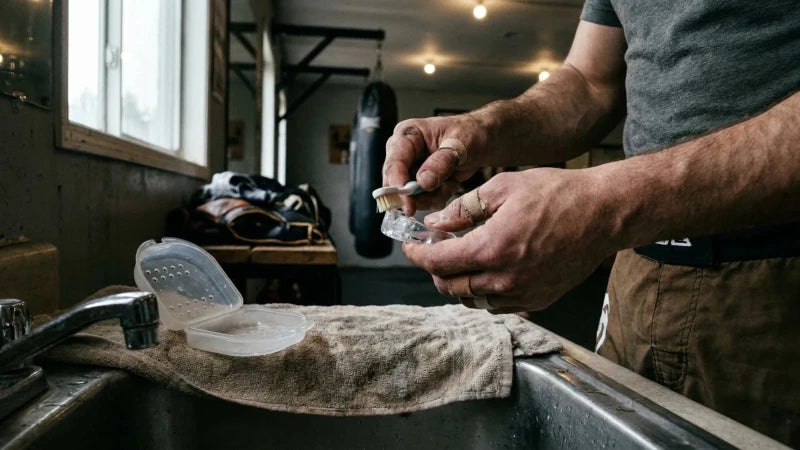
A properly fitted mouthguard can reduce the incidence and severity of injuries to the teeth and oral soft tissues in contact sports. It does not make head contact safe, and evidence that mouthguards reduce concussion risk is mixed.
For combat sports, fit matters more than a dramatic protection claim: the guard should stay in place without constant clenching and allow normal breathing and communication.
Choose the type
| Type | What it offers | Main limitation |
|---|---|---|
| Custom-made | Made by a dentist or dental professional for the individual mouth | Higher cost and a new fitting may be needed after dental changes |
| Boil-and-bite | Heat-moulded retail option with a more individual fit than stock | Poor heating or biting can produce thin, loose or distorted areas |
| Stock | Ready to wear with no moulding step | Limited fit adjustment and may require clenching to hold |
The American Dental Association discusses these three categories and emphasizes proper fit. “More expensive” is not the entire answer; a badly fitted guard is still a bad guard.
The combat-sports fit check
- The guard stays over the teeth when the mouth opens slightly.
- You can breathe normally through the mouth.
- You can speak well enough to communicate with a coach or official.
- No sharp edge cuts the gum, cheek or lip.
- The guard does not trigger constant gagging or force the jaw into pain.
Follow the manufacturer’s fitting instructions exactly. If a boil-and-bite guard will not hold after the permitted refit, replace it or discuss a custom option with a dentist.
Braces, dental work and growing athletes
Braces, implants, missing teeth, recent dental work and changing teeth need individual advice. Do not trim a guard around orthodontic hardware without guidance from the orthodontist or dentist.
For a child or teenager, recheck the fit as teeth and jaw shape change. Our kids’ combat-sports gear guide covers the wider parent checklist.
What a mouthguard does not prove
A mouthguard is primarily oral protection. It is not evidence that a round is safe, that a concussion cannot occur or that harder sparring is acceptable. The ADA notes mixed evidence on concussion reduction.
The same boundary applies to headgear. The headgear selection guide explains why laceration protection and brain-injury claims must not be conflated.
Rules: check the exact event
Mouthpieces are commonly required in regulated combat-sports competition, but the governing rules, inspection and consequences vary. The ABC Muay Thai rules specify a mouthpiece under the presiding commission, while the World Boxing rules control competition equipment within that rule set.
Ask the coach and read the current event packet. A product being marketed for boxing or MMA does not guarantee approval for every competition.
Clean and store it
- Rinse after each use and clean according to the manufacturer’s directions.
- Let it dry before closing the case.
- Use a rigid, ventilated case that is cleaned too.
- Keep it away from direct heat, pets and loose items that can deform it.
- Never share a mouthguard.
Replace it when it no longer stays in place, develops tears or sharp edges, becomes badly distorted, or dental changes alter the fit. Do not rely on a universal calendar.
Complete the kit without confusing the roles
A mouthguard covers one part of the equipment decision. Match current boxing and Muay Thai gloves to the class and use the essential gear checklist for the rest. Gloves, headgear and a mouthguard each have different jobs; none replaces coaching or contact control.
Stock, boil-and-bite or dentist-made?
A stock guard is ready to wear but offers the least individual shaping. A boil-and-bite guard can be formed at home when the instructions are followed precisely. A dentist-made guard is built from an impression or scan and is the route to discuss when fit is difficult, dental work is involved or the athlete wants a professionally managed option.
The category is only the start. Thickness, coverage and fit vary within each group. A custom guard can still need adjustment; a boil-and-bite guard can work well only if it stays over the teeth without constant clenching. Judge the actual fit, not the label.
Why a boil-and-bite fitting fails
- The water or heating time did not match the product instructions.
- The guard was bitten through or compressed unevenly while soft.
- The athlete sucked and pressed only at the front, leaving the sides loose.
- The model is too large for the mouth or triggers the gag reflex.
- It was reheated more times than the manufacturer permits.
If the guard drops when the mouth opens, digs into soft tissue or blocks ordinary breathing, it is not ready for contact. Use the product's permitted refit process or replace it. Do not cut structural areas by guesswork.
Event-day mouthguard check
Fit the competition mouthguard well before the event. Train with it in controlled sessions so breathing and communication are familiar. Bring it clean and dry in a ventilated case, and carry a fitted backup if the rules and your coach allow it. The backup should be a real fitted guard, not an unopened product you plan to shape at the venue.
Inspect both guards for tears, sharp edges and distortion. If recent dental work has changed the fit, ask the dentist before competition. A mouthguard is small enough to forget and important enough that it deserves a fixed place in the gym-bag system.
Sources and rule checks
- American Dental Association mouthguard guidance: Properly fitted mouthguards reduce the incidence and severity of oral injury; concussion evidence is mixed.
- Association of Boxing Commissions Muay Thai rules: The presiding commission controls required gear; the rules specify mouthpiece, glove and hand-wrap requirements.
- World Boxing Competition Rules: Competition equipment, hand-wrap and headguard requirements vary by age and event category.