


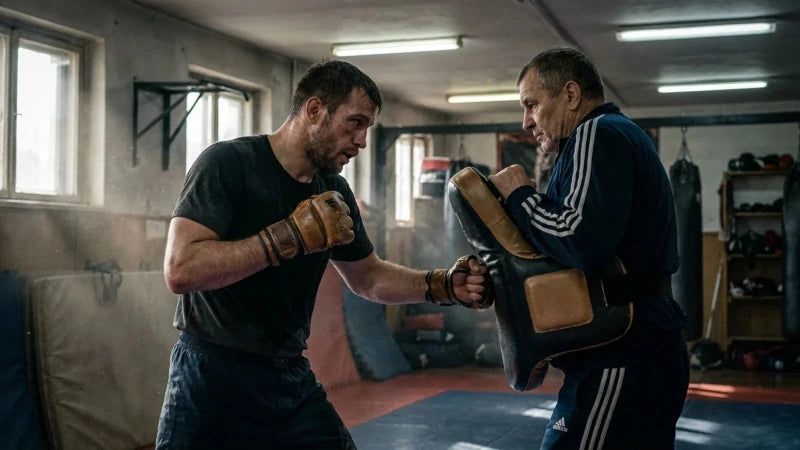
MMA gloves change the equipment constraints around striking and grappling; they do not create performance. Padding shape affects contact feedback, while exposed fingers and much of the palm preserve access for grips. Fit and closure decide whether those features stay aligned during movement.
| Design feature | Practical effect | Limit |
|---|---|---|
| Open fingers | Allows grips and finger movement | Less hand coverage than a boxing glove |
| Open palm | Direct contact for grappling | Does not guarantee grip strength |
| Knuckle padding | Changes contact feel and profile | No universal force-reduction value |
| Wrist closure | Secures the glove over the hand and wraps | Cannot correct poor technique |
| Thumb design | Changes coverage and mobility | Varies by model and drill |
Striking feel comes from more than glove weight
Competition-style gloves have a lower profile than padded sparring gloves. That changes the distance between fist and target and the feedback at contact. It does not prove more accuracy, faster hands or a specific increase in force.
Any comparison also needs two gloves in serviceable condition; worn foam changes the result.
The old article claimed MMA gloves delivered four to five times the peak force of boxing gloves and supplied detailed newton values without a traceable source or comparable test conditions. Those numbers are removed. Athlete, strike, target, glove condition and test protocol all affect a measurement.
Padding placement changes the contact profile
MMA padding is concentrated over the striking area so the palm and fingers remain available. A sparring design such as the Fairtex FGV18 adds coverage for partner work. A training model such as the Fairtex FGV17 uses a different balance of padding and open-hand access.
Neither is a default heavy-bag glove. For sustained power rounds, a closed boxing glove is usually the more practical route unless the coach sets a specific MMA-glove drill.
Open fingers preserve grappling access
Finger loops keep the glove attached while leaving the digits available for clinch positions, takedowns and ground work. The open palm lets the athlete contact the opponent or training surface directly. That is why a boxing glove cannot replicate MMA movement.
Finger openings can also pinch, rub or pull when the size is wrong. A glove that shifts over the knuckles or blocks normal opening and closing is not a performance upgrade; it is a fit problem.
Closure and wraps affect the whole system
A closure must secure the glove over the wraps used in that session. Too loose and the glove shifts; too tight and the hand can become numb. A longer or double closure can feel more structured, but no retail closure guarantees wrist stability or prevents injury.
Training, sparring and competition feel different
- Training gloves balance open-hand movement with a usable strike zone for technical work.
- Sparring gloves add padding and coverage for coach-controlled partner drills.
- Competition gloves are lower-profile and must be supplied or approved under event rules.
The same athlete can need all three categories across a camp. “Best performance” is therefore the wrong buying question. Ask which glove lets the planned drill happen without using competition equipment for routine sparring.
Fit checks before training
- Put on the exact wraps required for the class.
- Center the strike padding over the knuckles.
- Make a natural fist and open the hand fully.
- Check every finger opening and the thumb position.
- Secure the closure without numbness or sliding.
- Have the coach approve the model for partner contact.
Can you compare MMA glove performance online?
You can compare disclosed design: material, closure, padding coverage, thumb construction and intended use. You cannot infer your punch power, grip control or injury risk from a product page. Those outcomes depend on the athlete and session, not a feature list.
When design stops working
Retire a glove from contact when padding shifts or develops hard spots, the shell opens, finger loops tear or the wrist strap no longer holds. There is no component-by-component lifespan table. Condition determines whether the design still performs its basic job.
Use the MMA glove types guide, MMA vs boxing gloves and MMA glove fit and hand-safety guide. Compare current models in the MMA glove use-case ranking or MMA glove collection.
The same feature can help one phase and hinder another
More padding can make repeated striking work more tolerable, but it can also make gripping bulkier. A very open palm can improve hand access, yet the finger-loop geometry may become the pressure point. A long closure may feel secure in a punch and awkward during a post.
That is the central MMA glove tradeoff: no part works in isolation.
Test the glove through a short movement circuit
- Make ten relaxed fists and check whether the glove closes with you.
- Open the hand fully and spread the fingers.
- Form and release a light wrist grip.
- Post gently on the mat with the wrist in several angles.
- Shadowbox, then return to a grappling stance.
The Fairtex FGV17 is a training-format example worth judging through that circuit. Do not reduce the decision to its listed weight or material.
Performance ends where fit fails
If a finger loop cuts into the webbing, the thumb is pulled, or the closure shifts under technical work, stop. The glove is not “high performance” for your hand. A different size or model will do more than trying to adapt your technique around the equipment.