


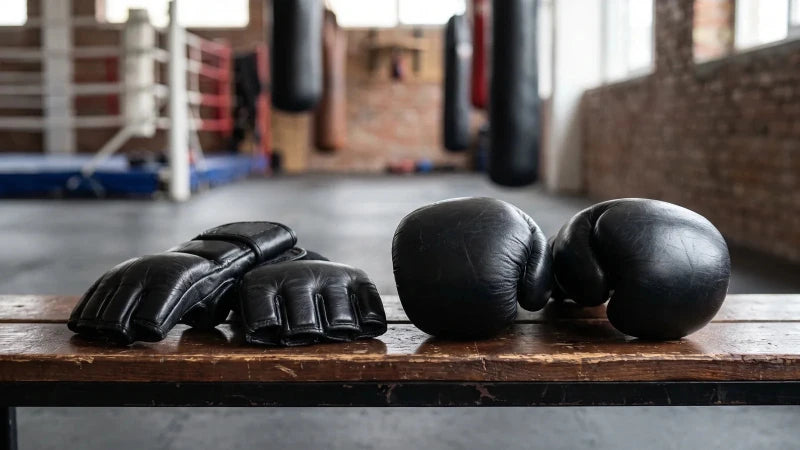
Use boxing gloves for boxing-style bags, pads and boxing sparring. Use MMA gloves for MMA drills that require an open hand, and only use the sparring or competition format your coach or event approves. If you train both sports, you may need both types.
| Feature | Boxing gloves | MMA gloves |
|---|---|---|
| Hand design | Fully enclosed fingers with a formed fist | Open fingers and palm for gripping and grappling |
| Common training use | Bags, mitts, pads and boxing sparring | MMA technique, ground-and-strike drills and coach-directed sparring |
| Padding | More coverage around the fist; profile varies by model | Lower-profile competition padding or fuller MMA sparring padding |
| Sizing | Often sold by ounce weight | Often sold as S, M, L or XL using hand measurements |
| Competition | Boxing commission or sanctioning body controls glove and weight | MMA event or commission controls glove and approval |
| Best default for heavy bag | Yes, when the model is intended for training | Only for a specific coach-directed drill |
The visible difference is the fingers. The buying difference is the job.
What are boxing gloves designed for?
Boxing gloves hold the fingers together in an enclosed hand compartment and place padding around the fist. Training models are built for jobs such as heavy bags, focus mitts, Thai pads and boxing sparring. Fight models follow competition rules and are a separate category.
They are the practical default when the session consists of repeated punches. The exact model still matters: a dense bag glove, a compact all-rounder and a soft sparring glove can share the same ounce weight but feel very different.
Use the boxing and Muay Thai glove guide to choose by training role, then the boxing glove weight guide to understand common 8 oz, 10 oz, 12 oz, 14 oz and 16 oz routes.
What are MMA gloves designed for?
MMA gloves leave the fingers and palm more open so the athlete can grip, pummel and grapple while still wearing strike-zone padding. The design changes by purpose:
- MMA training gloves balance hand mobility with padding for technical work.
- MMA sparring gloves add padding and coverage for controlled partner drills.
- MMA competition gloves use a lower-profile event format and are not the default for routine sparring.
The complete MMA glove guide covers fit, closure and use-case differences in more detail.
Can you use MMA gloves on a heavy bag?
You can use them for a specific drill when the glove maker and coach permit it, but a closed boxing training glove is the better default for sustained heavy-bag punching. It gives the hand an enclosed platform and offers more model options built specifically for bag work.
Do not turn “more feedback” from a small MMA glove into proof that it improves technique. If your wrist collapses or your hand hurts, the drill is not helping.
Can you use boxing gloves for MMA?
Boxing gloves work for the boxing portion of MMA training: bags, mitts and striking-only drills. They do not allow the grip and finger movement needed for wrestling, submissions or many wall and ground drills.
An MMA gym may deliberately switch between boxing gloves, MMA sparring gloves and bare-hand technical grappling in one program. Follow the equipment call for that round.
MMA gloves vs boxing gloves for sparring
Use the glove that matches the sport and the gym's partner-work rules.
- Boxing sparring: use the required boxing glove weight and a coach-approved model in good condition.
- MMA sparring: use the gym's extra-padded MMA sparring glove for drills that require an open hand.
- Mixed technical rounds: the coach may change the permitted techniques to match the glove.
Do not use low-profile competition MMA gloves as the routine sparring default. Do not assume every 16 oz boxing glove is partner-approved. Weight, padding profile, condition, athlete, partner and intensity all matter.
MMA gloves vs boxing gloves for competition
The rulebook decides. Association of Boxing Commissions championship guidance uses 8 oz or 10 oz gloves for professional boxing depending on weight class, subject to the supervising commission. ABC MMA committee guidance says professional MMA gloves must weigh at least 4 oz and be approved by the commission.
Those are not shopping formulas. Your event may supply the glove, restrict models or follow another amateur or professional rule set. Confirm before buying.
Do MMA gloves and boxing gloves use the same sizing?
No. Boxing gloves are commonly labeled by ounce weight, which describes the glove's weight rather than your hand size. MMA gloves commonly use letter sizes tied to a model-specific hand measurement.
In both cases, test the exact glove over the wrap setup used for the session. A glove should stay secure without numbness, thumb pressure or shifting padding.
Do you need both?
You likely need both when your weekly training includes sustained boxing bags or sparring and MMA drills that require gripping. Start with the glove needed for the class you attend now. Add the second type when the curriculum actually calls for it.
A sensible cross-training setup can be:
- A closed boxing training glove for bags and pads
- A separate boxing sparring glove if the gym requires one
- An open-palm MMA training or sparring glove for MMA rounds
- An event-controlled competition glove only when needed
Which glove should a beginner buy first?
Buy the glove your first class uses most. For a boxing or Muay Thai beginner, that is usually a coach-approved boxing training glove. For an MMA beginner, ask whether the early curriculum starts with boxing gloves, open-palm training gloves or both. Do not buy a competition glove just because it looks closest to what you see in a fight.
For current options, compare boxing gloves and MMA gloves after the coach has named the format.
The choice changes inside the same MMA class
An MMA session can move from heavy-bag rounds to takedown entries and controlled ground-and-pound. One glove rarely handles all three well. Boxing gloves make sense for dedicated striking volume. Open-finger MMA training gloves make sense when the hand must grip. Sparring equipment depends on the exact drill and coach.
A simple equipment split
- Heavy bag and boxing pads: boxing or Muay Thai training gloves.
- Grappling with light strikes: an MMA training glove approved by the coach.
- MMA partner rounds: the gym's required sparring format, not a retail competition glove by default.
- Sanctioned bout: promoter- or commission-controlled equipment.
Why owning both is not redundant
Boxing gloves protect the hand through repeated striking volume and cover the fingers, which makes gripping impossible. MMA gloves preserve hand access, which also leaves less padding around the contact area. Each tool keeps the design compromise appropriate to its job.
If you train both sports every week, two pairs are usually cleaner than forcing one pair across every drill. It also keeps bag wear away from partner-focused equipment.
Beginner decision
Buy the glove required for the first month of class, not the glove associated with the sport's biggest event. If the beginner program starts with boxing fundamentals, that may be a boxing glove. Add an MMA training glove when grappling-with-strikes enters the curriculum.
MMA vs boxing glove FAQs
Which has more padding, MMA gloves or boxing gloves?
Boxing gloves generally provide more enclosed fist coverage than low-profile MMA gloves. MMA sparring gloves add more padding than MMA competition gloves. Exact construction still varies by model.
Do MMA gloves hurt more than boxing gloves?
That cannot be reduced to the glove name. Technique, force, target, padding design, weight, condition and rules all affect impact. No glove makes full-contact training risk-free.
Can I spar in MMA competition gloves?
Not as the normal default. Use the extra-padded MMA sparring glove and drill rules set by your coach.
Can I grapple in boxing gloves?
Not effectively. Enclosed fingers prevent normal grips, so boxing gloves are used for striking-only portions of MMA training.
How do I care for each type?
Open and air-dry both immediately after training, clean according to the shell material and inspect padding, seams and closures. Use the dedicated MMA glove care guide for open-palm models and the boxing glove care guide for enclosed gloves.