


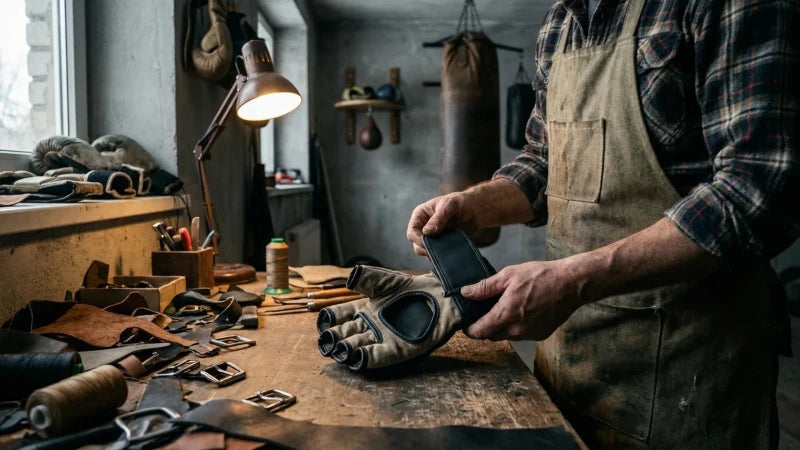
The safest custom MMA glove is a factory design or reversible identification that does not touch the contact or structural areas. Do not modify padding, finger loops, thumb design, seams, shell or wrist closure. Altered retail gloves are not automatically legal for competition.
| Option | Training risk | Competition reality |
|---|---|---|
| Factory colorway | Low | Still must be event-issued or approved |
| Removable bag or cuff tag | Low when non-contact | Remove if officials require it |
| Small non-contact label mark | Material and transfer risk | Ask before use |
| Paint, patch or embroidery | Can crack, transfer or create hard edges | Not a safe default |
| Padding or closure change | Structural alteration | Do not do it |
What “custom MMA gloves” can mean
Searchers may mean a custom color, a team logo, a name on the cuff, a manufacturer-made glove or a personally altered retail pair. These are not the same product. A factory option preserves the maker's construction; a DIY alteration can affect material, shape and inspection.
Low-risk ways to identify training gloves
- Put the athlete's name on the glove bag
- Use a removable tag on a non-contact cuff loop
- Choose a distinct factory colorway
- Ask the maker whether a small label-area mark is compatible
- Have the coach inspect any addition before partner work
Keep every addition away from the knuckle pad, back of hand, finger openings, thumb, palm, seams and closure. Anything raised, hard, abrasive or able to transfer should stay out of partner training.
Why paint, glue and embroidery are risky
MMA gloves flex around the fingers and palm while absorbing sweat and contact. Paint can crack or transfer. Adhesive can harden or lift. Embroidery punctures the shell or lining. A patch edge can catch on a partner or mat.
Material compatibility also varies. Cowhide, microfiber, PU coatings and vinyl do not use one preparation, pigment or sealant. A solvent that removes a leather finish can destroy a synthetic coating. There is no universal DIY recipe worth recommending for training equipment.
Never customize the structure
- Do not add, remove or reshape knuckle padding
- Do not cut or widen finger loops
- Do not change the thumb attachment
- Do not shorten or extend the wrist strap
- Do not sew through the shell, lining or foam
- Do not heat-mold a glove unless the manufacturer explicitly designed it for that process
Competition gloves are controlled equipment
ABC professional MMA guidance places fight gloves under promoter supply and commission approval. A personal pair with an athlete logo, custom padding or changed closure does not bypass that process. Even an unaltered model sold as “pro” or “competition” needs event authorization.
Use the MMA glove rules guide before planning bout equipment. For training gloves, the gym has the final say on partner-contact additions.
What about manufacturer-made custom orders?
A true factory custom order can preserve construction better than DIY work, but verify what is actually customizable, minimum quantity, warranty, production time and intended use directly with the maker. Do not quote generic $80–$250 price bands or four-week timelines; those change by manufacturer and specification.
Questions for a factory or team order
- Is the base model training, sparring or competition-style?
- Which surfaces can receive color, name or logo changes?
- Are padding, sizing and closure identical to the standard model?
- Does customization change the warranty or return policy?
- Can the maker provide a pre-production sample?
- Is the quoted lead time measured from artwork approval?
For a team, keep an exact size list and assign each athlete's pair. Matching graphics do not mean matching hand dimensions.
Custom fight gloves vs custom training gloves
A custom training glove is a purchase from a maker. A fight glove is controlled by the event. Do not pay a customization premium on the assumption that the personalized pair will enter a professional or amateur bout.
Factory design is usually the clean answer
If visual identity is the goal, choose from the current MMA glove collection and keep structural equipment untouched. Use the MMA glove types guide to select the base model and the MMA glove material guide before applying any maker-approved marking.
For closed-finger equipment, the boxing glove customization guide applies the same principle: reversible identification first, display-only artwork second, structural alteration never.
MMA gloves have more ways for a modification to go wrong
An MMA glove exposes the fingers and palm. That creates extra contact points: finger loops, thumb, open-palm edges and closure hardware. A small patch or stiff paint line can catch during grappling even when it would never matter on a display pair.
Before any training-use customization, flex the glove through a fist, open hand, post and light grip. Nothing you add should harden, lift, peel, transfer color or narrow a finger loop.
For teams, specify the job before the artwork
A factory order is the cleanest route for logos or coordinated colors, but the order still needs a technical brief. Ask which glove format is being customized, which materials and sizes are available, whether the artwork changes production time, and what sample approval looks like.
- Confirm training, sparring or display use.
- Request a physical sample before a full team run.
- Check every size; artwork placement can shift across the range.
- Ask what happens if the print cracks or transfers.
None of that makes a glove competition-approved. The promoter or commission controls fight equipment. Treat team customization and sanctioned-bout approval as separate lanes.