


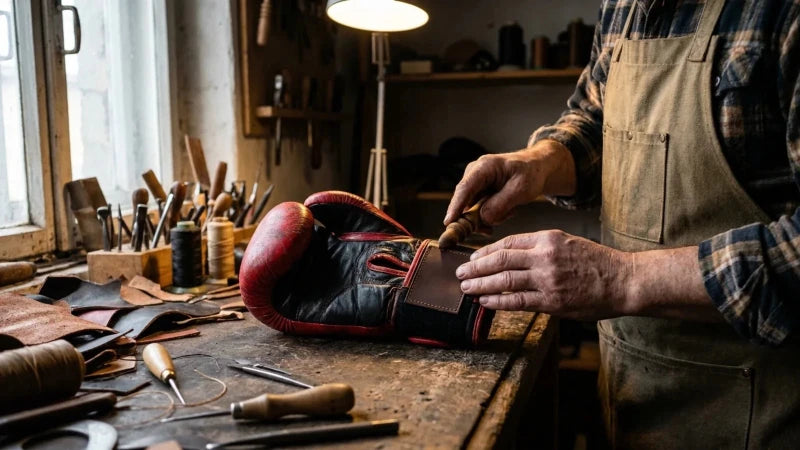
The safest boxing glove customization is reversible identification on the cuff or strap. A removable tag, approved name marking or color choice can distinguish your pair without changing the striking surface, padding, seams or closure. Paint, glue, embroidery, dye and structural alterations carry real material and competition risk.
| Customization | Risk level | Decision |
|---|---|---|
| Removable name tag on bag or cuff loop | Low | Best identification route when it cannot contact a partner |
| Small marker on an approved non-contact label | Low to medium | Check material and gym policy first |
| Paint or dye on the shell | Medium to high | Can crack, transfer or affect finish; use a specialist |
| Glue-on patch | High | Hard edge or adhesive can fail; avoid on training gloves |
| Embroidery through the glove | High | Can puncture shell, lining or padding; do not DIY |
| Padding, thumb, finger or closure modification | Unacceptable | Do not alter |
Start with the least permanent option
If the goal is finding your gloves in a busy gym, you do not need an art project. Add your name to the gear bag, use a removable tag or choose a distinctive factory color. Keep anything added away from the knuckles, thumb, palm, seams and partner-contact areas.
Before painting boxing gloves
Find the exact shell material. Genuine leather, microfiber, polyurethane-coated synthetic and vinyl do not accept the same preparation or paint. A solvent used to strip a leather finish can damage a synthetic coating, dye or adhesive.
Then check:
- The manufacturer's warranty and care instructions
- Whether the gym allows painted gloves for sparring
- Whether the paint can transfer when wet
- Whether the design crosses a seam or flex point
- Whether the glove may ever be inspected for competition
The glove material guide helps identify the base, but it does not authorize a coating.
Why paint and sealant can fail
Gloves flex, absorb sweat and make repeated contact. A coating can crack, peel, become sticky or transfer to equipment and partners. Surface preparation can also remove the factory finish. No generic paint system is proven safe across all glove materials.
If you want a painted pair for display, separate it from the gloves used in training. If you want a durable training design, a factory colorway is the cleaner purchase.
Can you use a marker on boxing gloves?
Only on a small, non-contact label or cuff area when the maker and gym allow it. Test a hidden spot for transfer, let it cure completely and keep the mark away from leather grain, synthetic coatings, seams and the striking surface. Permanent marker can bleed through light finishes and is not reversible.
For identification, marking the glove bag is safer than marking the glove. For artwork, ask a specialist who can identify the exact material and accept that the result may become display-only.
Do not glue or sew patches onto training gloves
Adhesive can harden or lift. A patch edge can catch on equipment or contact a partner. Sewing or embroidery can pierce the shell, lining or padding and introduce a failure point. Do not add hard, raised or abrasive elements to any glove used for partner work.
Never alter these areas
- Knuckle or back-of-hand padding
- Thumb attachment
- Finger compartment or grip bar
- Wrist strap, laces or closure hardware
- Seams or lining
- Any surface inspected for competition
ABC regulatory guidance requires inspected competition gloves to be clean, fit and unaltered. MMA guidance places event gloves under promoter supply and commission approval. Your personalized retail pair is not a shortcut into a sanctioned bout.
A safer customization process
- Decide whether the glove is for display, solo training or partner work.
- Ask the manufacturer whether the proposed material is compatible.
- Use reversible identification first.
- Keep all additions off contact, flex and structural zones.
- Test for transfer and rough edges before training.
- Have the coach inspect the glove before partner work.
When factory design is the better answer
Current ranges such as YOKKAO Matrix offer many factory colorways without changing the construction after purchase. That is usually the better route when appearance matters but the glove still needs to train.
Choose the right underlying model through the boxing and Muay Thai glove hub, then compare factory designs in the current collection. Care for any cosmetic finish with the material-safe cleaning guide.
Use a risk ladder before you touch the glove
Customization is not one decision. Writing your initials on a removable tag is not the same as painting the shell, sewing through the cuff or changing the closure. Start with the least permanent option that solves the actual problem.
- Identification: a name on a removable label or approved tape away from contact areas.
- Factory colorway: the safest route when appearance is the goal.
- Surface artwork: only after checking material compatibility, warranty and transfer risk.
- Structural alteration: do not do it. Padding, thumb, seams and closure are safety parts.
Run this preflight first
- Is the glove used for bags only, partner work or competition?
- Could the change create a hard edge, rough seam or color transfer?
- Will the solvent, adhesive or heat affect the shell or foam?
- Does the brand warranty exclude modifications?
- Can the gym or event reject the glove after the change?
If any answer is unclear, stop. A factory-designed pair is usually cheaper than replacing a good glove after a failed experiment.
Partner work changes the standard
A cosmetic flaw on a bag glove is annoying. A raised patch, exposed hook edge or hardened paint on a sparring glove can touch another person. Coaches should inspect any customized pair before it enters partner rounds, even when the change looks harmless.