


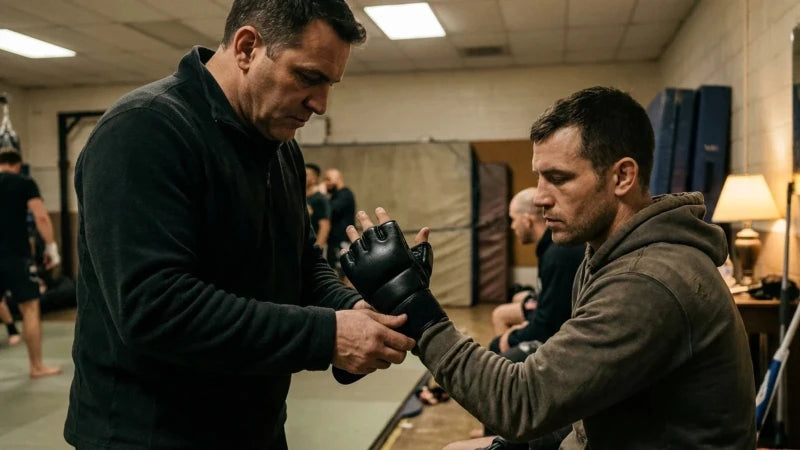
Under the Association of Boxing Commissions' professional MMA guidance, gloves must weigh at least 4 oz, be supplied by the promoter and be approved by the supervising commission. There is no blanket 6 oz maximum in that guidance. Amateur requirements can differ by jurisdiction, sanctioning body and event.
| Question | Professional MMA answer |
|---|---|
| Minimum glove weight | At least 4 oz under the ABC committee report |
| Maximum glove weight | No 6 oz maximum in the cited ABC guidance |
| Who supplies the gloves? | The promoter, not the athlete's retail kit |
| Who approves them? | The supervising commission or its inspector |
| Are amateur rules identical? | No; verify the exact jurisdiction and event rules |
What ounce gloves do UFC fighters use?
“Four-ounce gloves” is the common short answer, but it should not be read as a universal measured promise for every athlete and every glove size. ABC guidance sets a minimum of 4 oz. The promotion supplies the fight glove, and the supervising athletic commission approves the equipment used at the event.
That distinction matters because retail product names, glove sizes and promotional redesigns can change. A glove marketed as “UFC-style,” “pro” or “competition” is not automatically the glove an athlete may bring to a sanctioned bout.
For an actual bout, the useful answer comes from the event's current equipment notice and commission briefing, not a generic product listing.
The professional MMA glove explainer separates promotion-issued bout equipment from athletes' personal training choices.
The professional MMA glove rule
The ABC committee report states that gloves should be new for professional bouts, weigh at least 4 oz and be approved by the commission. It also removes the older assumption that gloves must weigh no more than 6 oz. The commission can require different gloves where hand size or safety oversight makes that appropriate.
The ABC's Unified Rules hub is the correct starting point for current rule documents, but the supervising commission remains the event-level authority. A national or international promotion does not erase local commission control.
How gloves are approved and inspected
- The promoter supplies the bout gloves. Athletes should not assume a personal retail pair can be substituted.
- Officials inspect the equipment. They check that the glove is the approved model, in suitable condition and free from unauthorized alteration.
- Hand wrapping is supervised. Gauze and tape requirements are part of the same regulatory chain, not a separate athlete preference.
- The glove is fitted under oversight. Inspectors can reject equipment or require a correction before competition.
- The event's direction wins. When an event bulletin and an old internet article conflict, use the commission's current written instruction.
This is why competition equipment should never be modified, softened with heat, cut, painted or structurally customized.
Professional and amateur MMA rules are not one system
The ABC report explicitly notes that there was no single nationally adopted set of amateur MMA rules at the time of the committee report. Amateur promotions may require more padding, a different glove shape or additional protective equipment. Some jurisdictions incorporate their own rules by regulation.
Do not copy a professional minimum into an amateur equipment checklist. Ask for the current rules from the event, sanctioning body or commission, in writing, before buying or packing gear.
Can you use retail competition gloves in a fight?
Only when the event or commission authorizes the exact glove. The YOKKAO Ground Pro is sold as a competition model and can make sense for coach-directed competition-style drills. That label does not override promoter supply, inspection or commission approval.
For ordinary classes, choose from training and sparring designs in the MMA glove types and fit guide. The MMA glove model comparison separates training, sparring and competition-style routes.
Competition glove checklist
- Get the rule document for the exact event and date
- Confirm whether the promoter supplies all bout gloves
- Confirm the supervising commission or sanctioning body
- Follow the event's hand-wrap and taping instructions
- Do not alter the glove or rely on a retail listing as legal approval
- Bring separate gloves for general training if the coach requires them
Use MMA gloves vs boxing gloves for the construction difference and the safe MMA glove break-in guide for training equipment. Browse the MMA glove collection for gym use, not as proof of competition eligibility.
The rulebook is only the first gate
Even when a commission publishes a glove range, the event can still control the approved supplier, colors, taping process and inspection. Fighters do not usually solve this by buying a retail pair that resembles a broadcast glove.
The practical chain is commission, promoter, rules meeting, equipment issue and inspection. Miss one link and a technically similar glove can still be rejected.
Questions to ask before fight week
- Which rule set governs this bout: professional, amateur or a local variation?
- Does the promoter supply the gloves?
- Which sizes or weights apply to the contracted weight class?
- Who supervises wrapping and glove application?
- When are gloves inspected and can a damaged pair be replaced?
Get those answers from the event, not a retailer or an old forum post. Rules can change, and amateur systems are especially local.
Training equipment remains a separate decision
Competition rules do not tell you what to wear for months of camp. Gyms commonly use more padded training and sparring formats to manage repeated work. Copying the event glove for daily sessions confuses legality with suitability.