


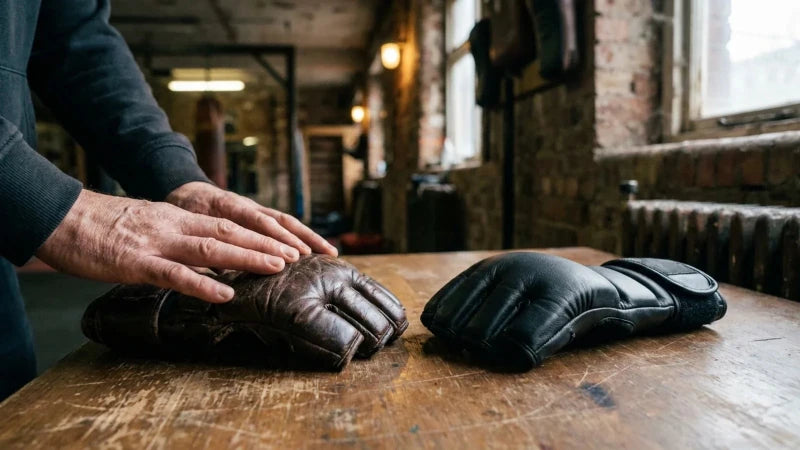
Choose MMA glove material after you choose the glove's job. Leather, microfiber and other synthetics change feel and care, but fit, padding, open-palm design and closure still determine whether a model belongs in training, sparring or competition-style drills.
| Material | Useful reason to choose it | Main caution |
|---|---|---|
| Cowhide or genuine leather | Traditional shell that can relax at flex points | Needs leather-safe care; no guaranteed lifespan |
| Microfiber | Verified non-leather shell with consistent finish | Do not apply leather conditioner |
| PU or vinyl synthetic | Can lower entry price | Quality varies; “synthetic” alone says little |
| Mixed construction | Materials can be assigned by component | Ask which parts each claim covers |
Leather MMA gloves
The Fairtex FGV17 uses genuine leather and is built as an open-palm training glove with a closed thumb. The Cleto Reyes Black Mamba uses cowhide and a double wrist closure.
Leather can become more compliant through normal use when the glove already fits. It does not stretch an entire size, and it does not make the foam, stitching or closure better by default. Keep the exterior clean, dry it away from heat and use only a conditioner approved for that finish.
Microfiber MMA gloves
The Fairtex FGV18 uses microfiber in an extra-padded sparring and grappling design. YOKKAO Ground MMA models also use microfiber. This makes them verified non-leather routes, not automatically cheaper, greener or less durable.
Microfiber generally does not need leather conditioning. Wipe it gently and follow the manufacturer's care instruction for the exact coating. Do not assume every synthetic cleaner or disinfectant is safe for it.
What the material label does not tell you
- How thick or soft the knuckle padding feels
- Whether the hand compartment suits your fingers
- How the wrist closure sits over wraps
- Whether the coach approves it for sparring
- How long the foam, lining or seams will last
- Whether a competition-style glove is event-legal
A leather training glove and microfiber sparring glove are not direct substitutes just because the shopper is comparing shells. The session comes first.
Compare both gloves over the same wraps so material is not confused with a sizing difference.
Does leather last longer?
Sometimes, but there is no defensible 12–18 month leather rule or 6–8 month synthetic rule. Frequency, sweat, bag work, drying, seams, foam and storage matter. A strong microfiber model can outlast a weak leather build, and internal padding can fail before either shell looks worn.
Does synthetic handle sweat better?
Some synthetic shells absorb less surface moisture, but the glove still contains lining, foam, seams and closures. Every pair needs to be opened and fully air-dried after training. Material does not make a wet gym bag acceptable storage.
Which material costs less?
Entry synthetic gloves often have a lower initial price, while cowhide models can cost more because of material and construction. Current price still belongs on the product page, not in a permanent article. Value depends on whether the model fits, does the required job and remains serviceable; a cheap wrong glove is not value.
Does non-leather mean eco-friendly?
No. Microfiber can satisfy a shopper avoiding animal leather, but that is a material choice rather than proof of lower environmental impact. A complete glove also contains foam, lining, thread, adhesive and closure materials. Environmental comparisons need specific product evidence.
Material decision shortcut
- Choose leather when you want the exact leather model and accept its care needs.
- Choose microfiber when a verified non-leather shell matters.
- Choose neither when the model role, fit or coach requirement points elsewhere.
- Reject any listing that hides the shell behind vague “premium material” language.
Which is better for beginners?
Choose the model the class actually needs. FGV17 is the leather general-training route. FGV18 or YOKKAO Ground Sparring are microfiber routes when the coach wants an extra-padded open-palm glove. A beginner doing mostly bags and pads may need a closed boxing glove before any MMA model.
Use the MMA glove types guide, the current model comparison and the MMA glove break-in guide. The MMA glove care guide separates leather from microfiber cleaning.
Browse the current MMA glove collection after the role and size are clear.
Compare complete gloves, not material swatches
The shell is only one layer. Finger-loop comfort, palm shape, lining, closure and padding decide how the glove works. A premium leather shell around a poor fit is not a better training tool than a well-built microfiber model.
Start with the session and fit. Use material to break the tie.
Where material differences become practical
- Leather: may soften and develop character, but needs compatible care and careful drying.
- Microfiber: gives a named non-leather construction and usually wipes clean easily; do not treat it with leather conditioner.
- Other synthetics: can range from basic vinyl to strong engineered shells. Ask for the exact material.
The Fairtex FGV17 gives you one current microfiber training glove to compare with leather options. Judge the finger loops, padding, closure and wrapped-hand fit—not just the shell description.
Cost per use is an outcome, not a promise
A more expensive leather glove is not automatically cheaper over time. Training frequency, sweat, drying habits, bag use and construction quality can outweigh the material label. Track condition. Replace the glove when the padding, seams or closure fail, even if the shell still looks good.