


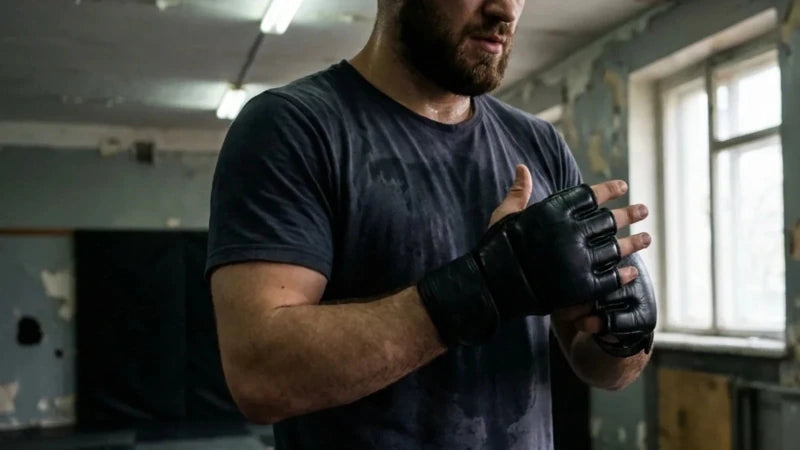
Break in MMA gloves by wearing them with your normal wraps through short, controlled sessions. Open and close the hand naturally, drill technique and let the gloves dry completely after each use. Do not soak, steam, heat, crush or bend them backwards.
Many microfiber and synthetic MMA gloves need very little break-in. Genuine leather can relax around the hand with use, but no material should need force before the glove becomes wearable.
| What you feel | Likely meaning | What to do |
|---|---|---|
| Firm padding and a snug new closure | Normal new-glove feel | Use short technical sessions and reassess |
| Mild resistance when opening the hand | The glove may need natural movement | Open and close the hand without forcing it |
| Numb fingers, sharp thumb pressure or tingling | Fit or wrap-volume problem | Stop; change the fit, size or wrap setup |
| Knuckle pad shifts away from the striking area | Wrong size or hand geometry | Do not try to “break” the pad into place |
| Wrist closure slides after tightening | Closure or sizing problem | Check the model and size before training |
Before break-in, check the fit
Put on the exact wraps you will use in class. Seat each finger opening, center the knuckle padding and secure the wrist. Make a fist, open the hand and repeat the movements your coach expects.
The glove should stay aligned without cutting circulation. Finger loops can feel close at first, but they should not pull the fingers sideways. The thumb should sit naturally. The wrist closure should secure the glove without a hard edge pressing into the joint.
Break-in cannot correct a glove that is the wrong size or shape. If you cannot make a natural fist, the strike pad sits off-center or your hand goes numb, stop. Compare the exact brand's chart or use a different model. Letter sizes do not transfer reliably between brands.
A safe MMA glove break-in routine
- Wear your normal wraps. Changing wrap thickness later changes the fit you just assessed.
- Move the glove by hand. Make a relaxed fist, open the palm and repeat for one or two minutes. Never fold the glove against its intended movement.
- Start with technical drilling. Use shadowboxing, light pad positioning or coach-approved grappling drills before hard impact.
- Keep the first sessions short. Check for rubbing, pressure points and pad movement rather than trying to “finish” break-in in one day.
- Dry after every session. Open the closure, remove wraps and let air move through the glove away from direct heat.
What not to do
- No hairdryer, radiator or hot car. Concentrated heat can affect foam, adhesives, coatings and shape.
- No soaking or steaming. Saturating the glove can trap moisture and damage materials.
- No oils inside the glove. They can create residue where the hand and wraps sit.
- No petroleum jelly. It is not a controlled treatment for leather, microfiber, foam or closures.
- No sleeping on, crushing or driving over gloves. Compression can deform the strike padding instead of improving fit.
- No hard bag rounds to force the issue. MMA gloves have less coverage than boxing gloves and are not the default for sustained heavy-bag punching.
Leather and microfiber do not break in the same way
The Fairtex FGV17 uses genuine leather, while the Fairtex FGV18 uses microfiber. YOKKAO Ground MMA models also use microfiber, and the Cleto Reyes Black Mamba uses cowhide.
Leather may become more compliant at natural flex points. Microfiber usually changes less, so persistent pinching is more likely a fit problem than a break-in problem. Do not put leather conditioner on microfiber. Even on leather, follow the maker's care guidance and keep any product away from the interior, foam, seams and closure.
How long should MMA gloves take to break in?
There is no honest universal session count. Material, construction, wrap thickness, hand shape and the starting fit all matter. The right question is whether normal movement is becoming easier without new pressure, shifting padding or damaged seams.
If the glove still creates numbness, sharp pressure or misalignment after a few controlled sessions, do not keep forcing it. Treat that as a fit decision.
Use the right glove for the session
An MMA sparring glove, training glove and competition glove are not interchangeable. Start with the MMA glove types and fit guide, compare current models in the MMA glove use-case ranking, and use MMA gloves vs boxing gloves before taking an open-finger model to the heavy bag.
After each session, follow the MMA glove cleaning and care routine. Browse the current MMA glove collection only if the existing pair fails the fit check.
MMA gloves need a movement check, not just a fist check
Boxing gloves mostly ask whether you can make a fist and hold the wrist securely. MMA gloves add finger loops, an open palm and grappling movement. A pair can feel fine on a punch and still pinch when you post, frame or close your hand around a wrist.
Before the first hard session, move through the positions the glove must allow:
- Make a fist without the finger loops cutting into the webbing.
- Open the hand and spread the fingers without the palm pulling tight.
- Close around a light grip and release it several times.
- Post gently on a mat and check that the closure does not dig into the wrist.
- Confirm that no hook material or rough edge is exposed for partner work.
A staged break-in that keeps the glove intact
Start with shadowboxing and controlled hand movement. Then use short technical rounds on pads or a light bag, provided the glove is designed for that work. Add drilling next. Partner contact comes last, after the coach checks the glove and you can open and close the hand without fighting it.
Dry the gloves fully between sessions. Damp lining can make the next session feel tighter, and leaving the pair zipped in a bag does more damage than a careful break-in can undo.
Stop if the fit gets worse
Numb fingers, a pulling thumb, a finger loop that leaves a sharp groove or a closure that shifts under light work are not signs to “push through.” They are reasons to stop. Break-in should reduce broad stiffness. It should not relocate pain.