


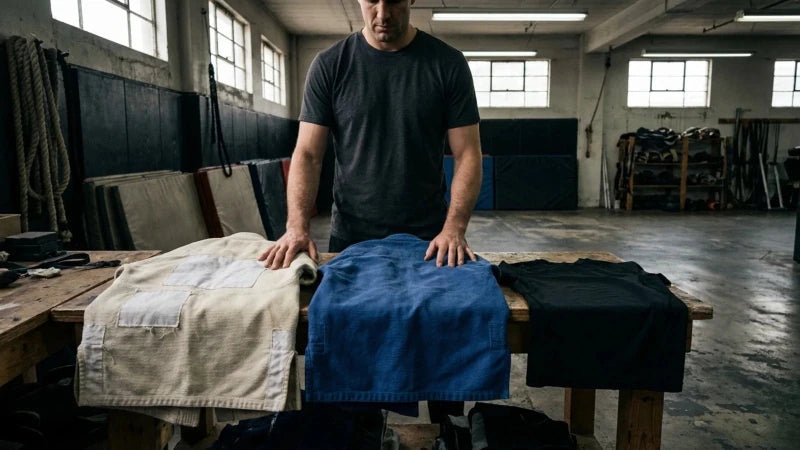
BJJ gear did not evolve in a straight line from a “basic cotton gi” to futuristic performance wear. The real change is more practical: one general uniform category split into equipment built for daily training, hot rooms, weigh-ins, different body types and formal competition rules.
Modern gear gives you more choices, but the buying decision is still physical. The fabric, cut, reinforcement, pants and rule set matter. Sensor claims and invented performance percentages do not.
For a kit-level overview, start with our complete BJJ gear guide.
The useful stages of BJJ gear development
| Development | What changed | What the buyer gains |
|---|---|---|
| Training gi specialization | Different jacket weaves, weights, reinforcements and pant fabrics | A choice between lighter handling and a more substantial daily-training feel |
| More precise sizing | Long, heavy and split-size options alongside standard A sizes | Better sleeve, torso, waist and inseam fit without unnecessary bulk |
| Competition-specific models | Uniforms built around current cut, color, patch and material rules | Less uncertainty at inspection, provided the exact model is currently approved |
| Dedicated no-gi kits | Fitted rash guards, grappling shorts and permitted compression layers | Clothing designed to stay close to the body without exposed hardware |
From one “gi” category to distinct training tools
A traditional-feeling gi and a lightweight gi are not a primitive-versus-modern comparison. They solve different problems.
Current product specifications show the range clearly. FUJI All Around with a 550-gram traditional-weave jacket and cotton twill pants. The FUJI Suparaito uses a 350-gram pearl-weave jacket and ripstop pants. Hayabusa's current Valor system uses a 400 GSM pearl-weave jacket and lets the buyer choose ripstop or twill pants.
Those figures describe jacket fabric, not the total uniform weight. A collar, reinforcements, pants, size and patches all change what the complete gi weighs and how it handles. Our lightweight versus heavyweight gi guide breaks down that tradeoff without pretending GSM tells the whole story.
Fit became a product feature, not an afterthought
Standard A sizing still exists, but brands increasingly offer long and heavier cuts. Some current systems even let buyers select jacket and pants sizes separately. That is a meaningful improvement for athletes whose torso, hip and inseam measurements do not land in one chart column.
The practical result is less excess fabric without forcing a tight uniform. Competition rules still set the outer boundary. The current IBJJF uniform requirements cover sleeve and trouser length, collar dimensions, material, colors and patch zones.
“Competition cut” is not enough proof by itself. Check the exact model and current event rules. Brand marketing, an old product review and a previous ruleset do not guarantee that the uniform will pass today's inspection.
No-gi became its own equipment system
No-gi training is not simply gi training without the jacket. The clothing has a separate job: stay fitted, remove exposed snag hazards and handle repeated ground contact.
Current IBJJF rules specify a skin-tight shirt long enough to meet the waistband, permitted colors and rank-color treatment. Shorts must meet length and hardware restrictions; the permitted compression layers differ by division. Academy rules can be more relaxed, so decide whether you are buying for class, competition or both.
Use our no-gi BJJ gear guide for the current checklist, then compare the rash guards currently stocked.
What has not changed
- Fit still comes first. A fashionable weave cannot rescue sleeves, seat or trousers that bind.
- Construction still matters. Reinforced stress points and clean seams matter more than vague “advanced fabric” language.
- Care affects ownership. Wash and dry the exact model according to its label; read our BJJ gi care guide.
- Rules can change. Verify current event requirements before altering, patching or buying a competition uniform.
How to choose modern BJJ gear
Start with the room and use case. A hot academy, frequent travel or a close weigh-in may make a lightweight gi attractive. Daily hard rounds may push you toward a more substantial weave and pants. An unusual build may make extended or split sizing more valuable than either fabric label.
Then separate training gear from competition gear. A gi can be excellent for class without being accepted at a particular event. Likewise, a rank-colored no-gi kit may be unnecessary for a casual academy but essential for registration day. Use the current BJJ gi collection to compare live stock after you settle the construction and rule requirements.
Finally, ignore “future of BJJ” claims that do not name a real, current product and source. A better weave, better cut or cleaner rule fit is useful innovation. An unsupported concept is not.
The changes that matter when you shop today
More jacket weights
Practitioners can choose a lighter jacket for heat and travel or a more substantial weave for a traditional daily-training feel. The tradeoff is no longer hidden inside one generic “BJJ gi” category.
Different pants systems
Cotton twill remains common, while ripstop reduces bulk and often dries faster. Reinforced knees, seam layout and drawstring design affect ownership as much as the jacket weave.
Better proportional sizing
Long, heavy, women-specific and split-size systems acknowledge that height, torso, hip and inseam do not always fit one standard A-size row. This may be the most useful modern improvement because it changes every round, not only the product description.
Clearer competition separation
Brands increasingly identify models built for current rules, but approval still has to be checked against the exact model and event. A competition label is a starting point, not permanent permission.
A realistic gear timeline for one athlete
A beginner may start in a durable midweight gi that is easy to size. After training through summer, that athlete may add a lighter rotation gi. When competition becomes real, the next purchase may be driven by scale margin and inspection rather than academy comfort. If no-gi classes enter the schedule, a fitted rash guard and grappling shorts become a separate system.
That progression explains the market better than a story about technology replacing tradition. The older gi did not become obsolete; the athlete's use cases multiplied.
How to judge an “innovation” claim
Ask whether the feature names an observable change. Lower jacket GSM, a different pants fabric, split sizing, reinforced knee length and a published care method can be compared. “Advanced performance fabric” without construction, testing or a live model cannot.
The best innovation is often unglamorous: a size that finally fits, a hem that stays put, a uniform that dries before tomorrow's class or a current rule-compliant cut.
Rules sources
Competition rules change. These are the current primary pages to recheck before registration or travel.
Frequently asked questions
Are modern BJJ gis pre-shrunk?
Some are, but pre-shrunk does not mean shrink-proof. Check the exact product page and care label. Warm washing or tumble drying can still change fit on current models.
Is a lightweight gi less durable?
Not automatically. Fabric weight is one variable among weave, yarn, seam quality, reinforcements, pants and use. Compare the complete construction.
Is every white, blue or black gi competition legal?
No. Color is only one requirement. Material, fit, collar, patches and the exact event rules also matter.
What was the biggest useful change in BJJ gear?
For many buyers, it is not a new material. It is having more purpose-built weights, cuts and size options for the way they actually train.