


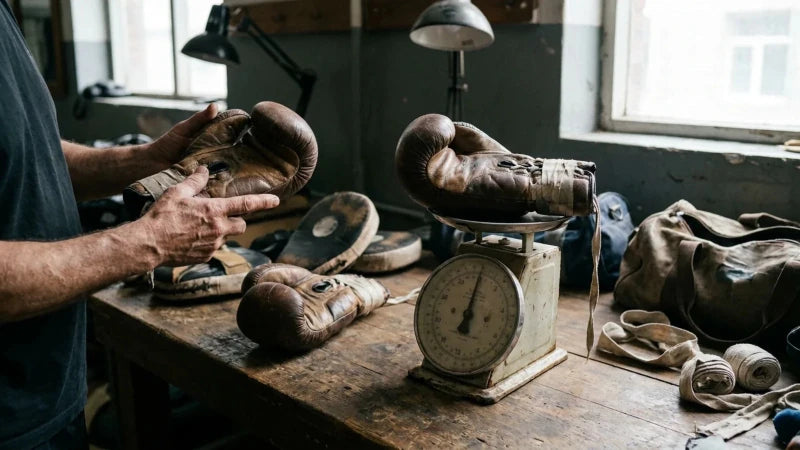
Choose boxing glove weight by the job, not by hand size alone. A lighter glove may suit fast pad work or a regulated bout. A heavier glove is often used for general training or sparring, but your gym, coach and event rules make the final call. The ounce number tells you the glove's total weight. It does not guarantee a particular fit, padding feel or level of protection.
If you want the short version, start here:
| Glove weight | Common use | What to check |
|---|---|---|
| 8 oz | Some professional bouts, speed-focused pads and selected bag work | Whether the rules or coach actually call for 8 oz; hand compartment may be compact |
| 10 oz | Some professional bouts, pads, bags and technical work | Competition rules and whether the glove still fits correctly over wraps |
| 12 oz | General bag and pad training, often for smaller athletes | Gym policy, hand fit and the model's padding character |
| 14 oz | General training and, in some gyms, controlled sparring | Partner-work rules; 14 oz is not accepted for every athlete or gym |
| 16 oz | Sparring and general training in many boxing and Muay Thai gyms | Your coach's requirement, your body weight and the condition of the glove |
| 18 oz and above | Coach-directed sparring or conditioning for some larger athletes | Whether the extra weight is useful for the session rather than simply tiring your shoulders |
Those are common routes, not universal rules. Two 16 oz gloves can feel completely different because the hand compartment, foam, cuff, balance and shape differ by model.
What does oz mean in boxing gloves?
Oz is short for ounces, a unit of weight. A 16 oz glove should weigh more than a 10 oz glove, but the number does not tell you exactly where that weight sits or how the glove will feel on your hand.
This matters because shoppers often treat glove weight like a shoe size. It is not. A person with a broad hand can find one 14 oz model cramped and another 12 oz model comfortable. Always check the model's size guidance and try it with the hand wraps you actually train in.
8 oz vs 10 oz boxing gloves
Eight-ounce and 10 oz gloves are the lighter end of the standard adult range. They are commonly associated with competition, but they are not interchangeable and they are not automatically legal for a bout.
Under the Association of Boxing Commissions' championship guidelines for professional boxing, fighters at welterweight and below use 8 oz gloves, while fighters above welterweight use 10 oz gloves. The supervising commission still has the final say, and the promoter supplies gloves that the commission inspects. Amateur boxing follows its own rulebook and event instructions.
For ordinary training, choose between 8 oz and 10 oz only after you know the purpose. A coach may use a lighter glove for precise pad work. Many gyms will want more glove for general training or any partner work. Do not carry a professional fight-glove rule into sparring class.
12 oz vs 14 oz boxing gloves
Twelve-ounce and 14 oz gloves sit in the middle of the training range. They can be useful when you want more substance than a fight-weight glove without moving straight to 16 oz.
- Choose 12 oz when your coach approves it for bags and pads and the glove fits correctly over wraps.
- Choose 14 oz when you want a heavier general-training glove or your gym accepts it for your form of partner work.
- Do not assume either is a sparring glove. Approval depends on your gym, body weight, training partners, the glove model and its condition.
If this is your first pair, the model can matter as much as the number on the cuff. Our beginner boxing glove guide covers fit, closure and training type before brand.
When should you use 16 oz gloves?
Many gyms use 16 oz as a starting point for adult sparring because it creates a simple house rule. That does not mean every athlete, every round or every 16 oz glove is automatically approved.
Ask your coach three questions:
- What glove weight does this gym require for my body weight and experience?
- Does the gym require a dedicated sparring glove rather than the pair I use on the heavy bag?
- Is this specific model and its current condition acceptable for partner work?
A worn 16 oz glove does not become partner-safe because the label still says 16 oz. Compressed padding, damaged lining, a rough closure or exposed seams are reasons to stop and inspect the glove.
Glove weight by training type
Heavy bag
For heavy-bag work, prioritize a stable wrist, a secure fist and the feedback you want from the bag. Depending on the athlete and model, that may lead to 10 oz, 12 oz, 14 oz or 16 oz. A denser bag glove and a softer sparring glove can share the same ounce label while doing different jobs.
Focus mitts and Thai pads
Lighter gloves can make fast combinations feel cleaner, while a general-training pair keeps your setup simple. Use the weight your coach wants for the drill, and do not sacrifice a sound wrapped-hand fit just to chase speed.
Sparring
Sparring is the least suitable place for a generic internet chart. Most adult gyms begin around 16 oz, but athlete weight, experience, sport, partner and local policy can change the answer. Some gyms also require a softer, dedicated sparring glove. Ask before buying.
Competition
The sanctioning body or commission chooses the permitted glove, and sometimes the exact approved model. You do not choose a competition glove from a training chart. Check the current event rules and instructions from the supervising body.
How to check boxing glove fit
Try the glove with wraps. Your fingertips should reach the end without being crushed or forced to curl. The thumb should sit naturally. The wrist closure should hold the glove in place without cutting circulation. Make a fist and open the hand several times.
New gloves can soften with normal use, especially leather models, but breaking in boxing gloves will not fix the wrong size, a bad thumb angle or numbness. If your hand tingles, loses feeling or cannot form a normal fist, stop.
Do you need more than one glove weight?
Not always. A beginner who only does bags and pads can start with one coach-approved training pair. A regular sparring athlete often benefits from keeping a dedicated partner-work pair away from heavy-bag wear. A competitor may also need a separate fight-rule glove, although that glove can be supplied and controlled by the event.
If you are deciding between models as well as weights, use the boxing and Muay Thai glove guide, then check the available ounce options in the boxing glove collection.
Why two gloves with the same ounce label can feel different
The number on the cuff is only the total glove weight. It does not tell you how wide the hand compartment is, where the foam sits or how firmly that foam rebounds. A compact 16 oz glove can feel tighter than a roomy 14 oz glove. A dense 16 oz bag glove can also feel very different on a partner from a softer sparring model at the same weight.
That is why the useful order is session, gym rule, fit, then ounces. Start with what you are doing. Confirm what your coach allows. Try the glove over the wraps you actually wear. The ounce label helps narrow the shelf; it does not finish the decision.
A quick wrapped-hand check
- Your fingertips should reach the end without curling under pressure.
- Your thumb should settle naturally instead of being pulled outward.
- The closure should hold the wrist without numbness or a large gap.
- You should be able to make a clean fist without fighting the glove.
If the weight is right but one of those checks fails, change the model or size. Moving to a heavier glove is not a reliable fix for a bad hand compartment.
Boxing glove weight FAQs
What ounce boxing gloves should a beginner use?
Use the weight your coach recommends for your sessions. For adult general training, 12 oz, 14 oz and 16 oz are common starting points. Your body weight, gym policy and planned sparring matter more than a universal beginner chart.
Are 16 oz gloves safer?
The ounce label alone cannot answer that. Glove design, padding condition, fit, technique, intensity and gym rules all matter. Sixteen-ounce gloves are commonly required for sparring, but that is not a guarantee against injury.
Can I use 10 oz gloves on a heavy bag?
Often, yes, if the glove is made for training, fits correctly and your coach approves it. A 10 oz professional fight glove is a different product from a 10 oz training glove, so check the model's intended use.
Can I spar in 14 oz gloves?
Only when your gym and coach approve them for you and your partner. Many gyms require 16 oz for adult sparring, and some require a specific sparring-oriented model.
Does glove weight determine hand size?
No. Ounces describe glove weight. Hand fit comes from the model's internal shape, size options, closure and how it feels over your wraps.
Once you have the right pair, keep it dry and inspect it regularly. The glove cleaning and care guide explains the routine without shortcuts that damage the lining or foam.