


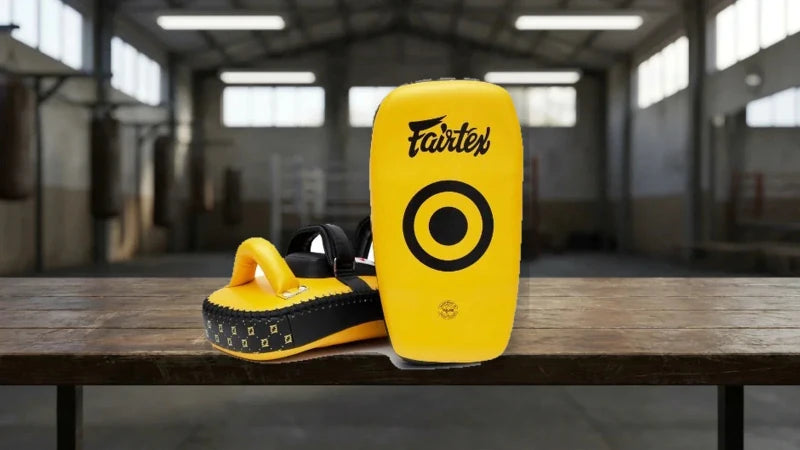
“Kick pad” can mean a Thai pad strapped to the forearm, a large kick shield, a low-kick target or a wall-mounted pad. They are not interchangeable.
For Muay Thai combinations, most buyers mean a pair of forearm-mounted Thai pads. Choose their size, curve, handle and weight around the holder—not around the hardest kick the striker wants to throw. If pads are one part of a larger gym setup, use the boxing, Muay Thai, MMA and BJJ gear checklist first.
Kick pad types, explained
| Type | Held where | Best for | Watch for |
|---|---|---|---|
| Thai pad | Forearm with handle and straps | Punch-kick-knee-elbow combinations | Pair weight, strap position and holder wrist angle |
| Kick shield | Across the torso or beside the body | Broad kick, knee and conditioning targets | Bulk, handle layout and safe bracing |
| Low-kick or leg pad | Against the holder’s thigh or leg | Low-kick drills | Secure fit and coach-led use |
| Focus mitt | Hand | Punch accuracy and fast calls | Too small for routine full-power kicks |
Need the punch-target comparison? Read focus mitts versus Thai pads.
How to choose Thai pads
Size
Smaller pads move quickly and suit tighter combinations. Larger pads give the striker more target and may spread contact over more surface, but the holder carries more bulk. There is no universal beginner size; hand, forearm, drill and session length all matter.
Curve
A curved face can help the striker find the center of the target. A flatter pad can feel different on straight-line shots. Neither shape fixes poor timing or pad presentation.
Handle and straps
The handle should let the holder keep the wrist close to neutral. Forearm straps need enough adjustment to stop the pad rotating without cutting circulation. Put both pads on before deciding; a single-pad fit test misses pair balance.
Weight
Weight matters most late in the round. If the holder starts dropping targets or flaring elbows, the setup is too demanding for that pace. A lighter model may be the smarter high-volume choice even when a heavier pad feels more substantial in the hand.
Shell and seams
Check material, edge binding, handle attachment, strap stitching and exposed hardware. Leather and microfiber options can both work. Use the model’s verified construction, not a blanket “leather always lasts longer” claim.
Current model families
Use the live kick-pad collection for models currently available from MMA Warehouse. Fairtex’s official kick-pad range currently separates standard curved pads, lighter or smaller formats, extra-thick and extra-long versions, kick shields and specialist leg targets.
Those names describe a job. They do not prove that a model is right for your coach. Match the job first, then compare the exact product page.
Basic holding principles
- Learn pad holding from a qualified coach before adding speed or power.
- Agree on the combination and intensity before the round.
- Keep the target connected to a stable stance; do not reach with a locked arm.
- Meet the strike with a controlled catch rather than swinging the pad into the limb.
- Keep fingers, elbows and the holder’s face out of the target line.
- Stop when either person loses balance, target position or communication.
This is a selection guide, not a substitute for in-person coaching. The same pad can be useful or reckless depending on how it is held.
Do you need one pad or a pair?
Most Muay Thai combination work uses a matched pair. Specialist low-kick pads, shields and body targets may be sold singly. Check the product page before ordering; photos do not always prove pack quantity.
Care and retirement
Wipe sweat from the face, handles and straps after use. Air dry fully outside the closed bag and away from direct heat. Check the handle base, strap stitching, edge seams and foam profile before every session.
Retire the pad when a handle or strap cannot hold, the foam shifts or bottoms out, a hard edge becomes exposed, or the shell tears across a working area. Do not rely on a made-up one-to-three-year clock.
Quick buying checklist
- Thai pad, shield or specialist leg target?
- Punches only, or punches plus kicks, knees and elbows?
- How long will the holder wear the pair?
- Do the handle and straps fit that holder?
- Is the listed price for one pad or a pair?
- Can the shell be cleaned with your gym’s routine?
For a smaller punch target, compare current focus mitts and use our focus-mitt buyer guide.
Current Fairtex kick-pad routes
| Model | Use case | Decision to verify |
|---|---|---|
| Fairtex KPLC5 Lightweight Kick Pads | A lighter pair for holders who prioritize movement and longer pad rounds. | Whether the reduced format gives enough target for the athletes and drills you coach. |
| Fairtex KPLS2 Superior Curved Kick Pads | A larger curved route for a more substantial forearm target. | Pair weight, forearm fit and whether the extra surface slows target changes. |
| Fairtex KPV Kick Pads | A current Fairtex pad option to compare against the lightweight and superior formats. | Exact product dimensions, handles, straps and pack quantity on the live page. |
Use those pages for current specifications and availability. Do not leave MMA Warehouse for a manufacturer catalog after the model has been identified; the commercial decision belongs on the retailer's exact PDP.
Small, standard or large?
Choose smaller when the experienced holder values fast repositioning and the striker can reliably find a tighter target. Choose standard when the pair must cover mixed daily work. Choose larger when newer athletes need more target or the drill benefits from added surface, provided the holder can manage the weight.
The holder's forearm length matters as much as the striker's size. A long pad can push into the elbow or wrist on a shorter holder. A small pad can leave a large holder gripping and bracing awkwardly. Wear both pads and present real target positions before deciding.
Why handles and straps deserve more attention
The handle determines the wrist angle. The straps determine whether the pad stays connected to the forearm. A comfortable strike face with a poor handle is still a poor pad. Check whether the hand can relax around the handle, whether the wrist remains neutral and whether the strap adjustment is usable with bare forearms and normal training sleeves.
After several low-intensity rounds, inspect the skin and circulation. Numb fingers, deep strap marks or a rotating pad are fit failures. Solve them before adding power.