


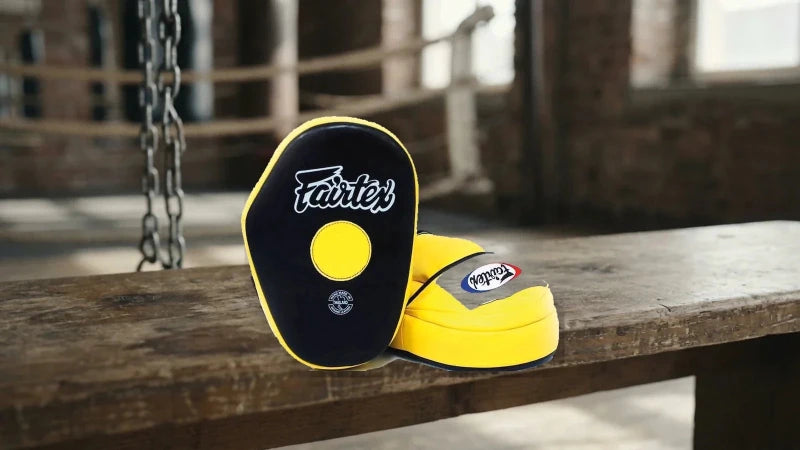
The best focus mitt is the one the holder can catch cleanly for a full round without fighting the hand pocket, wrist angle or weight.
Small mitts sharpen the target. Larger mitts are easier to find. Curved faces help receive straight punches, while angular and extended shapes suit different coaching styles. Start with the drills you actually hold. If focus mitts are one part of a larger setup, use the essential training gear guide to separate personal equipment from coach-held targets.
Choose the mitt by drill
| Mitt style | Best fit | Tradeoff |
|---|---|---|
| Compact or speed mitt | Accuracy, fast calls, experienced holder | Smaller target and less margin for a new striker |
| Standard curved mitt | General boxing combinations and everyday coaching | Not designed to receive every kick, knee or elbow |
| Large or maximized mitt | Beginners, broader targets and higher-volume classes | More weight and slower repositioning |
| Angular or specialty mitt | Specific hooks, uppercuts and coach-led patterns | Works best when the holder understands the intended angle |
If you need to catch kicks and knees, compare Thai pads instead. Our focus mitts versus Thai pads guide makes that decision quickly.
Five things to check before buying
1. Hand pocket
The holder should be able to relax the hand without the mitt falling off. A pocket that is too loose forces constant gripping. One that pinches fingers or crushes the thumb will not improve with wishful thinking.
2. Wrist position
Put the mitt on and hold a normal target. Your wrist should sit close to neutral. A thick wrist pad or strap can add stability, but it cannot fix a mitt whose angle fights your anatomy.
3. Target face
A visible center helps newer strikers. The face should match the drill: small for precision, standard for mixed combinations, larger for a broad catch. More surface is not automatically better.
4. Weight and balance
Pair weight matters to the holder. A mitt that feels fine for ten catches may drag after multiple rounds. Compare both the listed weight and where that weight sits in the hand.
5. Construction
Check the shell material, foam profile, seams, finger hood, palm grip and closures. Leather and microfiber can both be valid. The useful question is how the complete mitt handles sweat, repeated use and your care routine.
Current focus-mitt choices
The current MMA Warehouse focus-mitt collection is the live source for buyable models. Do not choose from an old listicle price or a model that no longer appears there.
Fairtex currently separates its range into compact, classic, angular, contoured and maximized shapes. The official Fairtex focus-mitt collection is useful for confirming model names and intended designs; it is not proof that one shape fits every coach.
Holder fit beats striker ego
Focus mitts are coach equipment. The striker does not get to choose the hardest shot the holder must absorb. Agree on combinations, pace and contact. Keep targets close to the holder’s frame rather than reaching with locked elbows.
New holders should learn from a qualified coach before running high-speed combinations. Stop when the wrist, elbow or shoulder starts losing position. Fatigue is not a cue to ask for more power.
Focus mitts or Thai pads?
- Choose focus mitts for punches, accuracy, head movement, footwork and quick visual calls.
- Choose Thai pads for kicks, knees, elbows and combinations that need a larger forearm-mounted target.
- Choose both only if the program uses both. More equipment does not replace a clear drill.
For the larger target, read the kick and Thai pad guide.
Care and replacement
Wipe the target, hand pocket and wrist area after use with a material-compatible method. Air dry away from direct heat. Inspect handles, straps, seams and foam before class. Replace a mitt when the hand no longer stays secure, a hard edge appears, the foam shifts or the target face tears.
There is no honest universal lifespan. A coach holding daily and a home user holding monthly are not on the same clock.
Focus-mitt buying checklist
- Which punches and combinations will you hold most?
- How experienced are the holder and striker?
- Does the pocket fit without a death grip?
- Can the wrist stay neutral at the catching angle?
- Is the pair light enough for the session length?
- Can you clean and dry the shell and pocket correctly?
Which current mitt should you compare?
Start with shape, then open the exact product page for current availability. These are different tools, not a best-to-worst ranking.
| Model | Best reason to shortlist it | Check before buying |
|---|---|---|
| Fairtex FMV9 Contoured Focus Mitts | A contoured target for a coach who wants a defined catch surface. | Hand-pocket security and whether the curve suits the holder's normal punch lines. |
| Fairtex FMV13 Maximized Focus Mitts | A larger target when visibility and margin matter more than minimal size. | Pair weight over full rounds and how quickly the holder can reposition. |
| Fairtex FMV15 Focus Mitts | An open-fingertip format for a holder who deliberately wants that hand design. | Finger position, grip and wrist angle; open fingertips are not automatically more comfortable. |
| YOKKAO Focus Mitts | A current YOKKAO route for buyers building a coordinated pad setup. | Exact dimensions, material and pocket fit on the live product page. |
What a first pair should do well
A first pair does not need the smallest target or the most unusual angle. It needs a secure pocket, a predictable face and a weight the holder can manage without dropping the hands. That makes a standard curved mitt the useful baseline for most boxing combinations. Specialty shapes make sense once the coach can name the drill they improve.
Buy for the primary holder. If several coaches share the pair, choose the pocket and adjustment range that works for the group rather than the one athlete with the largest hand. When possible, test both mitts through stance, target changes and a full round at low intensity. A pocket can feel secure at rest and still slide once sweat and movement arrive.
Diagnose fatigue before blaming the padding
Forearms burning early can come from a loose pocket that forces a constant grip. Wrist soreness can come from a target angle that makes the holder bend the hand back. Shoulder fatigue can come from an oversized pair or from presenting every target too far from the frame. Different foam will not fix those setup problems.
If the mitt rotates, do not compensate by gripping harder for months. Recheck pocket size, palm grip and wrist support. If the pair is simply too large for fast work, move to a smaller target. The correct mitt lets the holder focus on timing and feedback instead of keeping the equipment attached.