


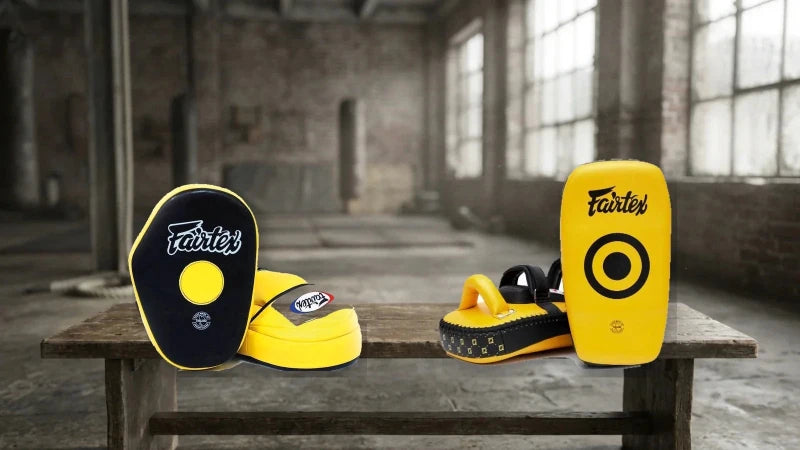
Hand pads usually means focus mitts: small targets worn on the hands for punch accuracy, timing and fast calls. Thai pads strap to the forearms and present a larger target for punches, kicks, knees and elbows.
Neither is universally better. Choose the tool that matches the strike, the holder’s skill and the round you are actually coaching. If this is one decision inside a larger setup, use the boxing, Muay Thai, MMA and BJJ gear checklist first.
Focus mitts versus Thai pads
| Decision | Focus mitts | Thai pads |
|---|---|---|
| Primary target | Punches and compact hand combinations | Punches, kicks, knees and elbows |
| Target size | Smaller and more precise | Larger forearm target |
| Holder movement | Fast calls and angle changes | More bracing and full-body positioning |
| Holder load | Usually less forearm bulk | Pair weight matters across longer rounds |
| Best first use | Boxing-style accuracy and rhythm work | Muay Thai or kickboxing combination work |
A kick shield and belly pad are separate tools again. The kick-pad guide explains the full category.
Choose focus mitts when
- The drill is mainly punches, defensive reactions or short combinations.
- The coach wants a small, clear target and quick call changes.
- The holder needs less forearm bulk for a longer technical session.
- The striker is not expected to throw routine full-power kicks into the target.
Target shape, pocket fit, wrist angle and pair weight matter more than a generic ranking. Use the focus-mitt buyer guide before comparing current focus mitts.
Choose Thai pads when
- The round combines punches with round kicks, knees or elbows.
- The holder needs more target area and forearm support.
- The coach can present and brace the pads without locking the arms.
- The pair’s handle, straps and weight fit the actual holder.
Thai pads do not automatically make a drill more “real.” The quality comes from clear combinations, correct target placement, controlled intensity and feedback.
Use both in the same program
A sensible striking program can use mitts for punch detail and Thai pads for whole-body combinations. That does not mean changing tools every round. Give each round one clear job:
- Technical mitt round for punch placement and defensive return.
- Thai-pad round for punch-to-kick or knee combinations.
- Controlled integration round only after the holder and striker own the pattern.
A belly pad can add a hands-free body target to either holder setup. Read the belly-pad selection guide before stacking equipment on the holder.
Holder fit decides the purchase
For mitts, check that the hand pocket secures the palm without a crushing grip and that the wrist can stay neutral. For Thai pads, check both handle and forearm straps, then wear the pair through stance changes.
Stop the fit test if fingers go numb, a strap cuts circulation, the target rotates or the holder must bend the wrist to keep it in place.
Safe progression
- Learn both tools from a qualified coach.
- Agree on combination and intensity before each round.
- Start with placement; add pace and power only when both people stay balanced.
- Do not improvise kicks to a focus mitt unless the coach has designed the drill.
- Retire any pad with failed handles, straps, displaced foam or exposed hard edges.
Fairtex’s official focus-mitt range and Thai-pad range show the current shape and format differences. Use those model details to compare construction—not as proof that one category is safer or better.
The buying answer
Boxing-focused coach: start with mitts. Muay Thai or kickboxing coach: start with Thai pads. Mixed striking program: own both only when each has a defined use. If the holder fit is poor, the right category is still the wrong product.
If you can buy only one
For boxing-only coaching, buy focus mitts. They make the holder quicker, keep the target small and suit punch placement, slips and short defensive returns. For Muay Thai or kickboxing combinations, buy Thai pads. Their forearm-mounted shape is built around a wider strike set.
Do not split the difference by asking a focus mitt to receive repeated hard kicks. Do not buy large Thai pads for a boxing coach who needs rapid, small target changes. A mixed gym will eventually use both, but the first pair should serve the sessions that already happen every week.
Why the same round feels different
Focus mitts reward visual precision. The striker has less target, and the holder can change levels or angles quickly. Thai pads reward connected combinations: punch into kick, kick into knee, body shot into a larger target. The pad does not create the coaching goal; its size and mounting make certain goals easier to organize.
Holder fatigue changes too. Mitt fatigue often shows up as grip and wrist tension. Thai-pad fatigue often shows up across the forearms and shoulders because the pair is larger and must be braced. That makes pair weight and handle geometry commercial features, not trivia.
Current internal routes
- Compare the Fairtex FMV9 Contoured Focus Mitts when a shaped punch target is the job.
- Compare the YOKKAO Focus Mitts when you want a current YOKKAO hand-pad route.
- Compare the Fairtex KPLC5 Lightweight Kick Pads when a lighter forearm pair matters.
- Compare the Fairtex KPLS2 Superior Kick Pads when you deliberately want a larger curved Fairtex option.
Open the product pages side by side and compare the holder interface first: pocket or handle, wrist position, straps and pair weight. The logo is the least important part of that comparison.
When the equipment is not the problem
If targets keep arriving late, combinations are unclear or the holder is reaching with locked arms, changing pads will not repair the round. Slow the drill down, agree on the sequence and have a qualified coach correct the hold. Better equipment is valuable; it is not a substitute for timing and communication.