


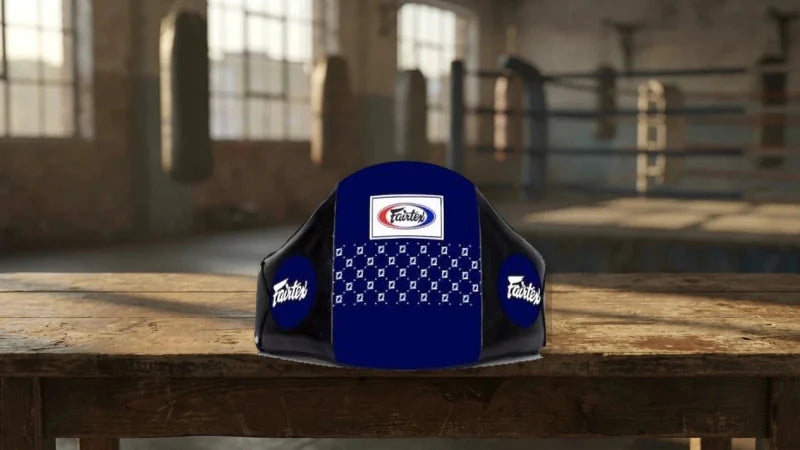
A belly pad is holder equipment for body-shot, knee and front-kick drills. It gives the striker a clear torso target while the coach or partner still controls distance, angle and intensity.
It is not body armor for uncontrolled power. The right pad is the one the holder can secure, move in and present without exposing the ribs, hips or hands. If a belly pad is one part of a larger gym order, use the boxing, Muay Thai, MMA and BJJ gear checklist first.
What a belly pad is for
- Body punches and punch-to-body combinations
- Knees and controlled front kicks to a coached target
- Combination work with Thai pads or kick shields
- Teaching range and target placement without turning every drill into hard sparring
A belly pad does not replace Thai pads, focus mitts or partner protection. It fills a different role: a wearable torso target that leaves the holder’s hands available.
How to choose a belly pad
| Decision | What to check | Why it matters |
|---|---|---|
| Coverage | Center target, ribs and lower edge in your normal stance | Too little coverage can expose the holder; too much can block movement |
| Closure | Buckle, hook-and-loop or lace system stays secure during pivots | A shifting pad changes the target and forces constant adjustment |
| Weight and profile | Holder can move, call and combine it with other pads | Bulk becomes obvious during longer rounds |
| Target shape | Flat or contoured face matches the drills you hold | A clear center helps the striker place shots |
| Shell and seams | No hard exposed edges; handles and closure points are reinforced | These are the areas most likely to interrupt safe use when damaged |
Fit the holder, not the striker
Put the pad on over the clothing the holder normally wears. Tighten it enough to stop rotation, then breathe, bend, pivot and bring the elbows down. The pad should remain centered without restricting normal breathing.
If the closure sits on a painful pressure point or the edge catches the hip, change the position or model. Do not “train through” a bad holder fit.
Choose for the full pad-work setup
A coach who wears a belly pad while holding Thai pads needs room to rotate, frame and call combinations. A large pad may offer more target, but it can also interfere with the forearms. Compare the full setup, not the belly pad in isolation.
Belly pad versus kick shield
| Belly pad | Kick shield |
|---|---|
| Worn around the torso | Held by handles |
| Leaves both hands available for mitts or Thai pads | Can be moved to torso, side or leg-level targets |
| Best when the drill repeatedly returns to the body | Best when a broad movable target is the main tool |
| Fit and closure are central buying decisions | Handle layout and holder bracing are central buying decisions |
Many serious pad sessions use both, but a new coach does not need both on day one. Buy for the drills already in the program.
Use it without turning the drill reckless
- Learn the pad position from a qualified coach before taking full-power knees or kicks.
- Agree on the combination and intensity before the round starts.
- Keep the pad centered and the holder balanced; stop if it rotates or loosens.
- Build power only after both people can place and receive the strike consistently.
- Do not use a belly pad to normalize shots outside the agreed target.
Browse current belly pads only after deciding on coverage, closure and the rest of the holder setup. Fairtex’s official belly-pad range is useful for seeing how target shape and closure systems differ across models.
Care and retirement
Wipe the strike face, edges and closure after use, then air dry fully away from direct heat. Check buckles, hook-and-loop, laces, stitching and the foam profile before the next round.
Stop using the pad if it will not stay secure, the padding shifts or bottoms out, a rigid edge becomes exposed, or a closure point starts tearing away. Condition decides retirement—not an invented replacement calendar.
For a complete holder setup, compare the focus-mitt and Thai-pad roles before adding more equipment.
Two current belly-pad routes
| Model | Reason to compare it | Holder check |
|---|---|---|
| Fairtex BPV2 Champion Belt Belly Pad | A lightweight Fairtex route for a holder combining a torso target with pad work. | Closure range, center position and whether the edges interfere with elbows or hips. |
| YOKKAO Belly Pad | A current YOKKAO microfiber option for the same core body-target job. | Exact dimensions, closure and how the target sits on the primary holder. |
Choose between them by the holder's torso, normal clothing and the drills paired with the pad. A belly pad that looks compact on a product photo can still sit too high on a shorter torso. A broad target can still be wrong if its edges stop the coach closing the elbows around Thai pads.
How tight should a belly pad be?
Tight enough that the strike face stays centered through stance changes, not so tight that the holder cannot breathe and brace normally. Put it on, exhale, bend at the hips, turn both directions and lift the arms into the normal pad-holding position. Recheck the closure after a few minutes because clothing and sweat can change the feel.
Do not use the belt to pull an incorrectly shaped pad into position. If the center target sits over the ribs, the lower edge jams the hip or the closure lands on a painful point, compare another shape.
What belongs in the same coaching setup?
A belly pad makes most sense when body punches, knees or front kicks are already part of coached combinations. Pair it with focus mitts for punch-led work or Thai pads for punch-kick-knee sequences. A kick shield remains the easier large target for some power and conditioning drills.
The buying test is therefore not “Which belly pad absorbs the most?” It is “Can this holder wear it securely while presenting the other targets the program uses?” That is the difference between equipment that gets used weekly and equipment that stays on a shelf.